• Key Features & Attributes
  • Ratings & Reviews
  • Know your Supplier
  • Product description from supplier

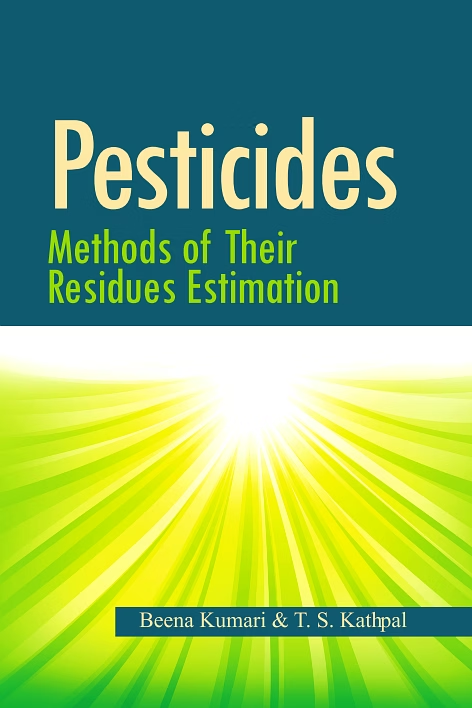
Pesticides: Methods of Their Residues Estimation (Hardback, Beena Kumari & T.S.Kathpal)

Brand: nipa

Inclusive of all taxes

The book 'Pesticides: Methods of Their Residues Estimation' by Beena Kumari & T.S. Kathpal provides an exhaustive analysis of both traditional and advanced analytical methods used for assessing pesticide residues in various matrices, including soil, water, and food commodities. This essential resource covers extraction techniques, clean-up processes, and the quantification methods necessary for accurate detection of pesticide residues. It meticulously discusses modern pesticides and their metabolic pathways, equipping readers with a foundational understanding crucial for both research and practical applications. In addition to historical insights into pesticide development, the book offers detailed insights into cutting-edge techniques such as Thin Layer Chromatography (TLC), Gas Liquid Chromatography (GLC), High-Performance Liquid Chromatography (HPLC), High-Performance Thin Layer Chromatography (HPTLC), and supercritical extraction. A unique feature of this book is its focus on the recently developed multi-residue methods that allow for efficient estimations, which are outlined in a dedicated chapter. The structure of the book is coherent, making it valuable for professionals in agriculture, food safety, and environmental analysis.

Key Features

Features Description
Authors Beena Kumari & T.S. Kathpal
Coverage Traditional and modern analytical methods
Techniques discussed TLC, GLC, HPLC, HPTLC, Supercritical Extraction
Focus Area Pesticide residues in soil, water, and food commodities
Unique Chapter Practices on newly developed multi-residue methods
Educational Purpose Serves as a critical resource for research and practical applications.
Attributes Description
Book Type Hardback
Publisher Self-Published
Publication Year 2023
ISBN Number 978-XXX-XXXX-XX-X
Pages 225
Language English

*Disclaimer: The above description has been AI-generated and has not been audited or verified for accuracy. It is recommended to verify product details independently before making any purchasing decisions.

Be the first to write a review

The book discusses advanced techniques such as TLC, GLC, HPLC, HPTLC, and supercritical extraction.

Yes, it provides a brief history of pesticide development alongside modern practices.

The primary focus is on methods for extracting, clean-up, detection, and quantification of pesticide residues in soil, water, and food.

Yes, there is a separate chapter that outlines the recently developed multi-residue methods for pesticide residue estimation.

This book is targeting professionals in agriculture, food safety, and environmental analysis.

  • Incorporation Type

  • GST

  • GST Registration Date

  • Number of Employees

  • Import Export Code (IEC)

  • Year of Establishment

  • Nature of Business

  • GlobalLinker Member Since

Brand: nipa

Country Of Origin: India

This book presents a comprehensive overview of the traditional and modern analytical methods utilized in the sample preparation of various matrices for the extraction, clean-up, detection, and quantification of pesticide residues in soil, water, and food commodities. It also covers some Quenchers methods, which are a type of extraction cum clean-up technique. The book provides a brief history of pesticide development, as well as information on the modern pesticides and metabolic pathways of selected xenobiotics from different groups of pesticides, which helps to understand the basic nature of pesticides. The latest analytical techniques, such as TLC, GLC, HPLC, HPTLC, super critical extraction, and chromatography, are discussed in a simple and concise manner. The book details the sampling extraction, clean-up, and solid phase extraction techniques for residue analysis, and it also outlines the recently developed multi-residue methods in a separate chapter.

The latest analytical techniques, such as TLC, GLC, HPLC, HPTLC, super critical extraction, and chromatography, are discussed in a simple and concise manner. The book details the sampling extraction, clean-up, and solid phase extraction techniques for residue analysis, and it also outlines the recently developed multi-residue methods in a separate chapter.


Contents


1. Introduction. 2. Pesticide metabolism in insects, plants and animals. 3. Sampling, extraction and clean-up. 4. Thin layer chromatography (TLC). 5. Gas liquid chromatography (GC). 6. High performance liquid chromatography (HPLC). 7. Supercritical fluid chromatography (SFC). 8. High performance thin layer chromatography (HPTLC). 9. Maximum residue limits (MRL). 10. Multi-residue methods for estimation of pesticide residues. 11. Glossary.


Agriculture And Farm Consultants

Horticulture Consultants

nipa

Pesticides

Residues Estimation

Analytical Methods

Agricultural Analysis

HPLC

GLC

Pesticide Metabolism

Environmental Safety

Pesticides: Methods of Their Residues Estimation (Hardback, Beena Kumari & T.S.Kathpal)

Brand: nipa

Inclusive of all taxes

You Save: 0
Send Inquiry
nipa genx electronic resources & solutions

North Delhi , India

Service Provider , Manufacturer, Professional Services, Brand Owner, Distributor, Exporter, Importer, Wholesaler, Startup

  • Secure
    Transaction

  • Day
    Dispatch

Report a problem with this product

Market Insights

Stay informed with the latest market trends, quality guides, and industry analysis

Indian Seasonings & Spices: Quality Standards, Sourcing Tips and Market Opportunities for Buyers & Sellers

Learn how to source and sell Indian spices such as black pepper, red chillies, turmeric and cardamom with quality, compliance, and global market insights.

Sustainability in Black Pepper Farming: Why Ethical Sourcing Matters for Your Business

Learn why sustainable black pepper sourcing matters, how it protects your brand, and what to ask from ethical suppliers today.