• Key Features & Attributes
  • Ratings & Reviews
  • Know your Supplier
  • Product description from supplier

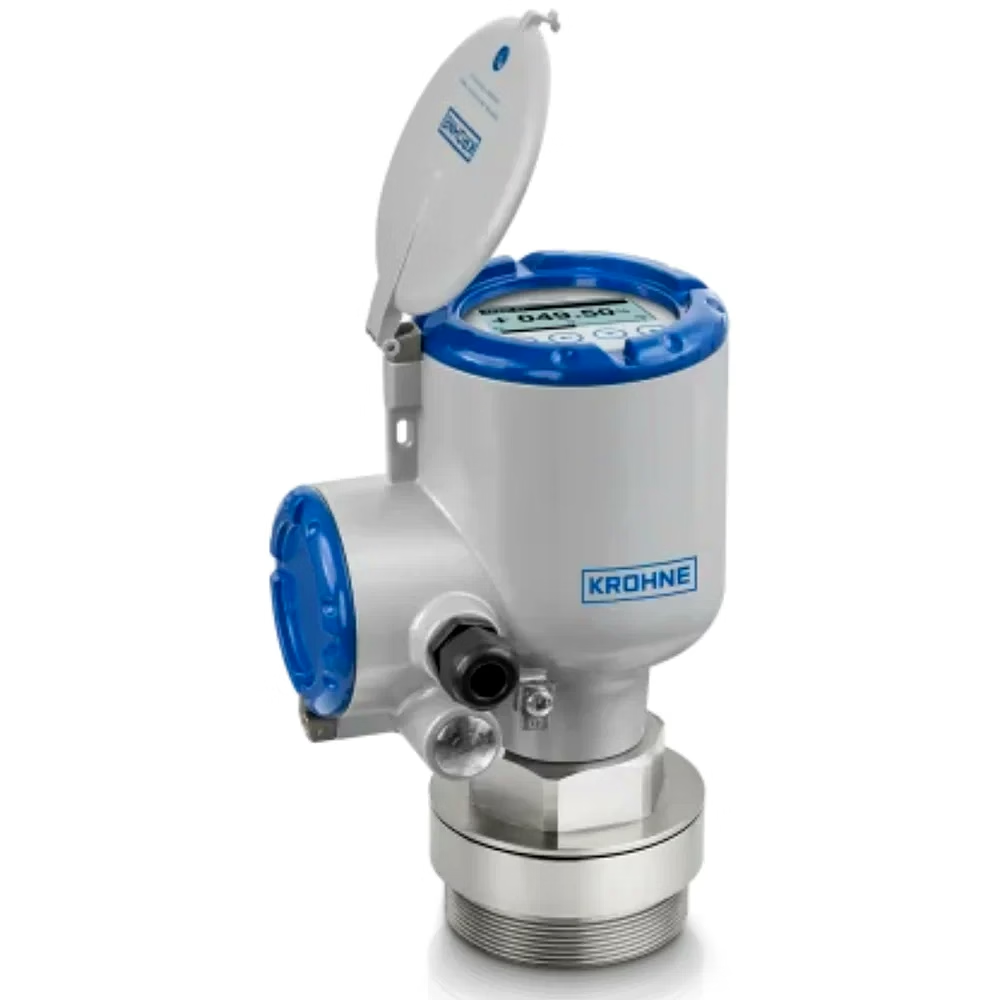
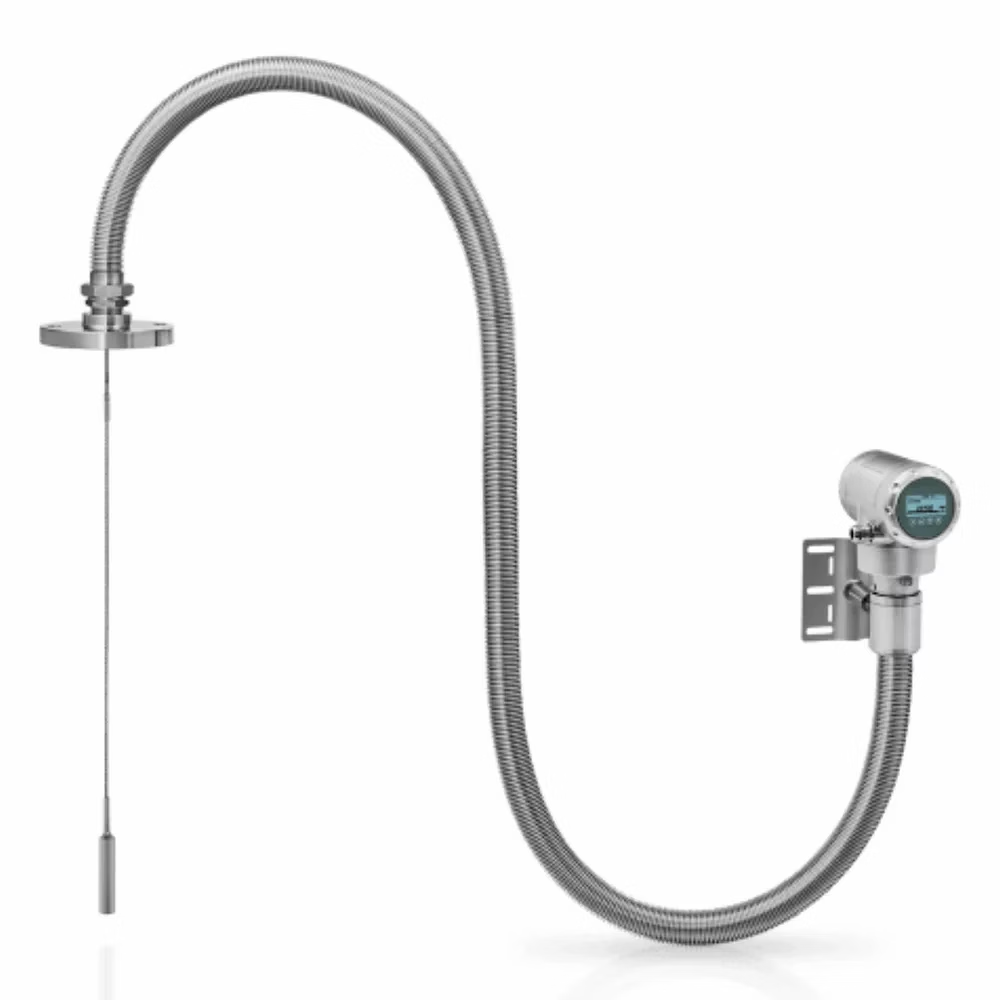
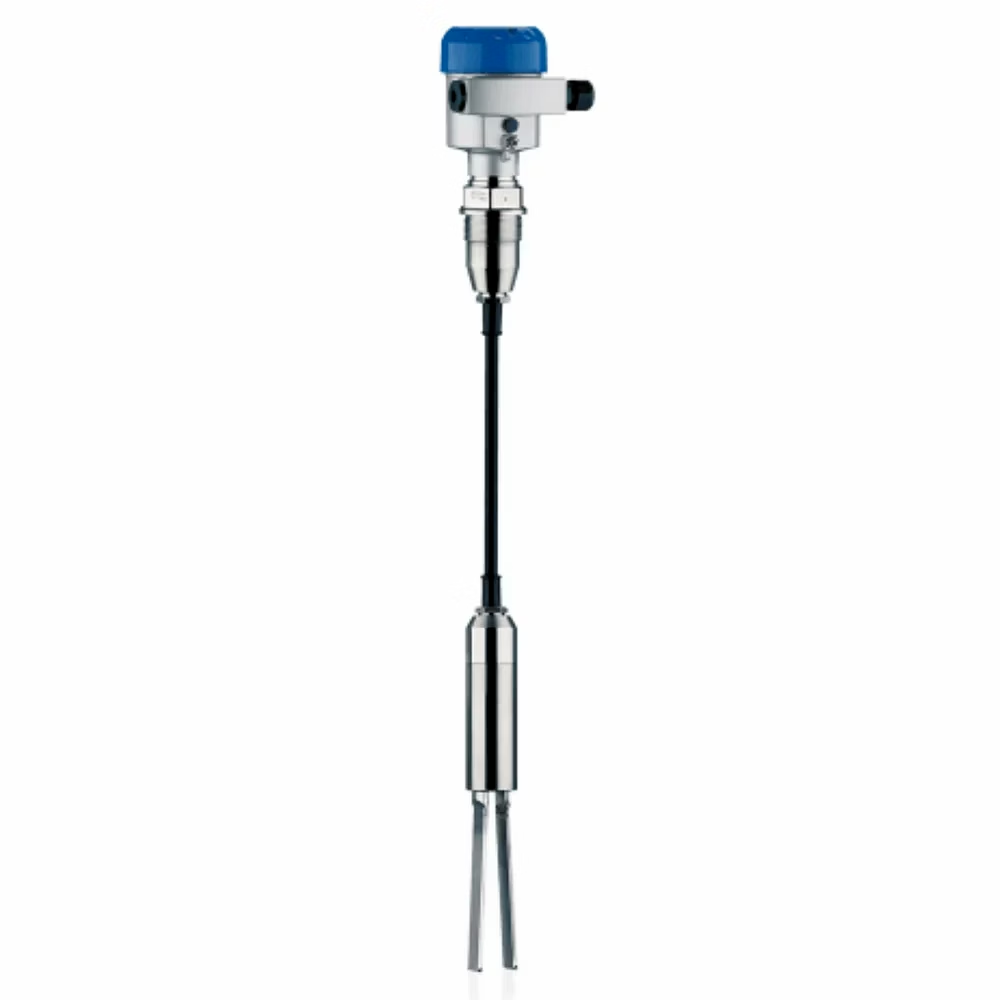
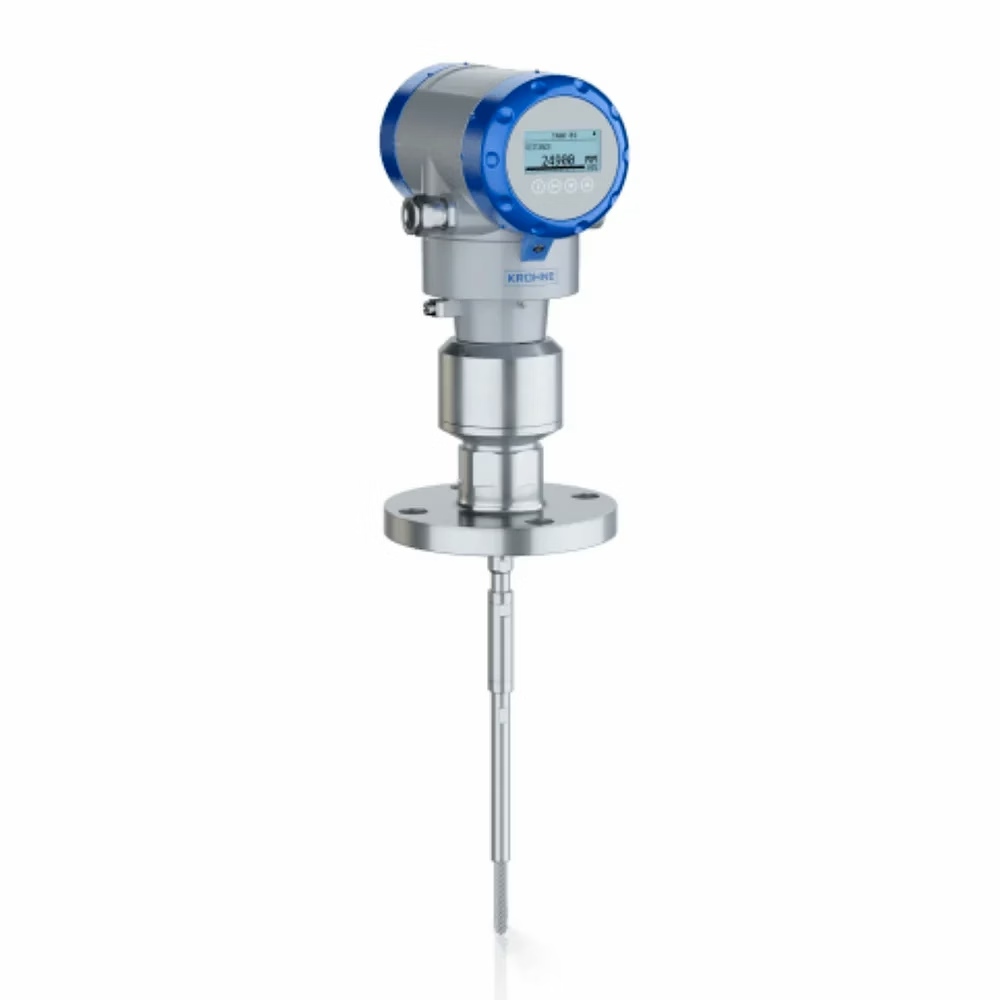
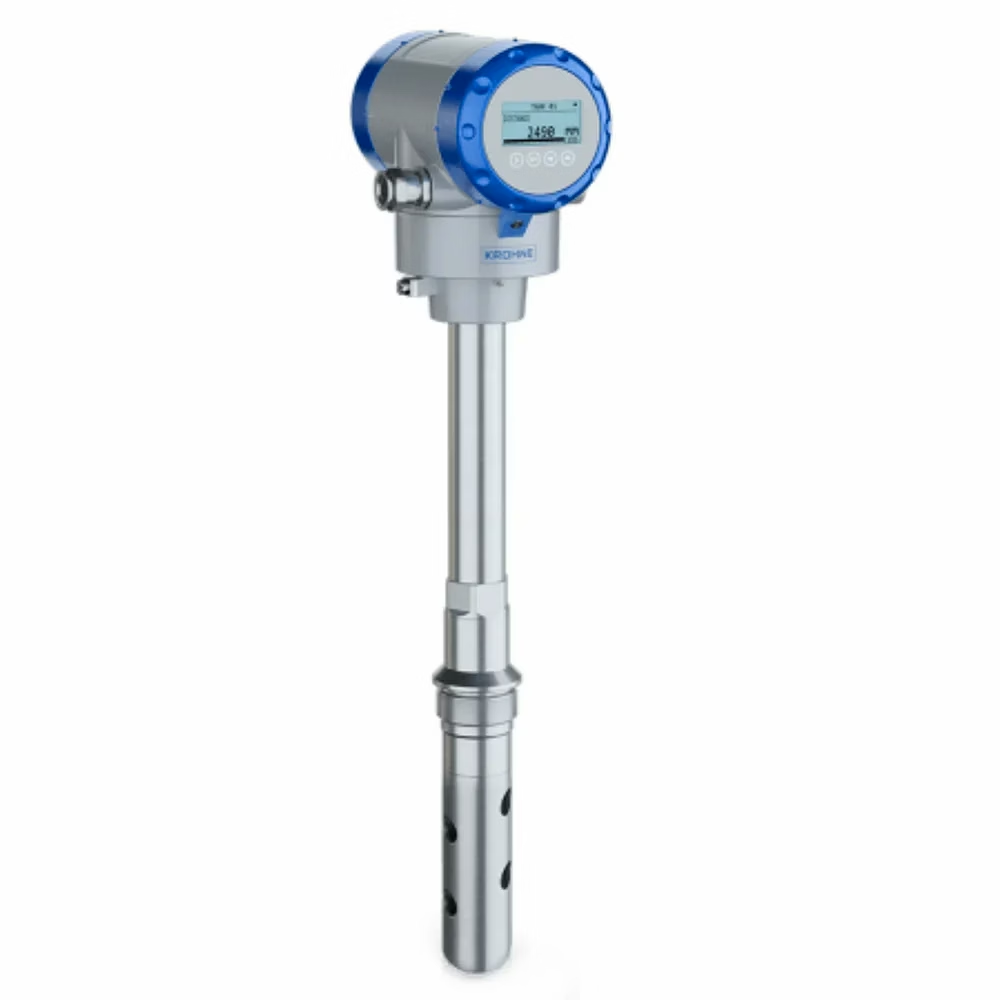
OPTIFLEX 7200 Guided radar (TDR) level transmitter for advanced liquid applications

Inclusive of all taxes

The OPTIFLEX 7200 Guided Radar (TDR) Level Transmitter is a cutting-edge solution engineered for advanced liquid applications requiring precise level measurement. Utilizing Time Domain Reflectometry (TDR) technology, this 2-wire level transmitter offers unparalleled accuracy in monitoring liquid levels across various industrial environments. With a focus on accuracy, durability, and user-friendly operation, the OPTIFLEX 7200 is ideal for measuring distance, level, volume, and mass in liquids with varying dielectric constants. Its robust construction allows it to withstand harsh process conditions, providing dependable performance even under extreme pressure and temperature. Equipped with advanced signal processing, the instrument ensures reliable measurements even in turbulent, foamy, or vapor-rich media. The device is compatible with a broad range of liquids, including aggressive chemicals, ensuring versatility in applications such as chemical processing, water treatment, food and beverage production, and pharmaceutical industries. Featuring a compact design with easy integration into existing control systems, OPTIFLEX 7200 supports multiple communication protocols, enabling seamless data transmission and remote monitoring. Factory calibrated with a wide measuring range, it minimizes installation time and reduces maintenance costs. This guided radar level transmitter is designed for industrial scale liquid level monitoring with proven precision and long-term reliability, making it a top choice for businesses looking to optimize inventory management and process control.

Key Features

Features Description
Measurement Technology Guided Radar (Time Domain Reflectometry, TDR)
Application Advanced liquid level measurement
Measuring Range Up to 40 meters
Media Compatibility Suitable for liquids with varying dielectric constants, including aggressive chemicals
Output Signal 2-wire system for easy wiring and integration
Environmental Resistance Robust construction to withstand high temperature and pressure
Accuracy High precision level, distance, volume, and mass measurement
Communication Protocols Supports multiple protocols for remote data monitoring
Installation Compact design with easy integration
Durability Designed for harsh industrial environments
Attributes Description
Measurement Principle Time Domain Reflectometry (TDR) Guided Radar
Sensor Type 2-wire guided radar level transmitter
Measuring Range 0.6 to 40 meters
Measured Variables Level, Distance, Volume, Mass, Dielectric constant
Compatible Media Liquids including aggressive chemicals, water, oils, and industrial fluids
Process Temperature Range -40 °C to +150 °C (may vary depending on configuration)
Process Pressure Range Up to 40 bar
Output Signal Type 4-20 mA with HART communication
Power Supply 9 to 36 V DC
Enclosure Rating IP67 or higher for protection against dust and water
Material Stainless steel or other corrosion-resistant materials
Mounting Type Threaded or flange mounting options
Display Optional local display with configuration interface

*Disclaimer: The above description has been AI-generated and has not been audited or verified for accuracy. It is recommended to verify product details independently before making any purchasing decisions.

Be the first to write a review

Yes, with suitable material configurations such as stainless steel, the OPTIFLEX 7200 is designed to measure levels of aggressive chemical liquids reliably.

Yes, the transmitter supports multiple communication protocols including HART, which makes it compatible with most PLC and DCS control systems.

The OPTIFLEX 7200 can operate reliably under process pressures up to 40 bar, depending on the configuration.

The device offers an optional local display for configuration and real-time level readings, but it can also operate entirely remotely.

Yes, the guided radar TDR technology utilized in this transmitter effectively measures levels even in liquids with low dielectric constants.

  • Incorporation Type

  • GST

  • GST Registration Date

  • Number of Employees

  • Import Export Code (IEC)

  • Year of Establishment

  • Nature of Business

  • GlobalLinker Member Since

Brand: shakti power solutions

Country Of Origin: India

OPTIFLEX 7200 Guided Radar Level Transmitter – TDR Guided Radar Probe

OPTIFLEX 7200 is an advanced guided-wave radar (TDR) level transmitter optimized for precision measurement of liquids and interfaces in complex vessel geometries. A guided probe architecture confines the electromagnetic pulse along a conductor (cable or rod), delivering consistent reflections even in environments with heavy vapor, foam, or surface turbulence. The unit architecture supports high temporal resolution for detecting thin interface layers in phase-separation monitoring. Production supports OEM and private-label programs with per-unit calibration logs and configuration snapshots. Packaging includes conductor protection and anti-vibration crates for multimodal transport. This component is essential for facilities requiring high-fidelity liquid level and interface data with documented time-delay calibration and probe-alignment verification for rapid site commissioning and procurement quality assurance.

Key Features

  • Guided-wave pulse path → ensures stable echo detection by confining signal energy to the probe, bypassing headspace vapor and internal vessel obstructions.
  • Phase-separation monitoring → utilizes high-resolution timing electronics to detect and track interface levels between immiscible liquids with different dielectric constants.
  • Modular probe architecture → features field-adjustable lengths and selectable metallurgy to match specific vessel depths and chemical compatibility requirements.

Technical Attributes

  • Measurement Principle: TDR time-of-flight → selection parameter defining the accuracy and temporal resolution for interface detection.
  • Probe Interface: Cable / Rigid Rod → selection based on vessel height, agitation levels, and potential for probe sway.
  • Output Configuration: 4–20 mA + HART / Digital → determines compatibility with process control loops and advanced asset management software.
  • Calibration Protocol: Time-delay logs → provided per unit to support traceable site commissioning and installation acceptance.

TDR Probe Construction and Signal Guidance Logic of the OPTIFLEX 7200

The technical framework of the OPTIFLEX 7200 Guided Radar Level Transmitter utilizes Time-Domain Reflectometry (TDR) measurement logic where nanosecond electromagnetic pulses are channeled along a dielectric guide. The structural reasoning for this guided-wave approach is to maximize the "echo-to-noise ratio" by preventing signal dispersion into the headspace—a failure mode known as "signal scattering" that decommissions unguided radar in narrow vessels. Measurement physics rely on the pulse reflection at the interface of different dielectric media; a failure in the probe’s electrical continuity—due to mechanical fatigue or chemical etching—results in "impedance mismatch," manifesting as false-level spikes and a total loss of Span accuracy. This leads to inaccurate inventory totals and potential pump dry-runs. The transmitter utilizes "dynamic gain adjustment" to maintain signal fidelity across varying liquid dielectrics (εr). Quality consistency is managed through serialized time-delay calibration logs that verify the pulse velocity for every unit. Failure to maintain probe alignment—due to improper anchoring—results in "probe contact" with the vessel wall, effectively decommissioning the measurement loop through high-resistance grounding.

Functional Performance and Interface Detection in Obstructed Vessels

Operational efficiency is achieved through the device’s ability to provide simultaneous measurement of total level and interface level (e.g., oil over water). Functional performance centers on the unit’s support for advanced pulse-shape analysis; if the interface layer is too thin (< 50mm), standard sensors fail to distinguish the two echoes. The 7200 utilizes high-speed timing electronics to resolve these close-proximity reflections. In real operational scenarios, a failure to manage "probe buildup"—especially in viscous or crystallizing media—results in signal attenuation; the 7200 utilizes "buildup compensation" logic to subtract the static reflection of the coating from the active surface echo. If the unit detects a loss of probe integrity or a sensor fault, it triggers a diagnostic alarm via its digital output, allowing for event-driven maintenance. Thermal management is critical for the head-mounted electronics; the unit utilizes a thermally-decoupled flange to protect the ADCs from hot process vessels. By providing a stable and guided signal, the transmitter effectively improves the safety and throughput of separation processes, reducing the need for manual sampling and laboratory verification of interface levels.

Institutional Deployment and Logistical Readiness for Guided Sensors

Designed for chemical layering, oil/water separation, and complex process tanks, the OPTIFLEX 7200 is configured for the logistical requirements of global multi-site procurement. Units ship in reinforced crates with internal conductor supports to protect the long cable or rod probes from bending or kinking during transport. Failure to implement probe-stabilized packaging results in "coaxial misalignment," which manifests as a significant loss of signal accuracy upon site commissioning. For international procurement, supply-readiness is supported through per-unit calibration certificates and compliance declarations (ATEX/PED). Export-ready documentation includes unit configuration snapshots and probe anchoring diagrams provided with each shipment to facilitate rapid site integration. Packaging utilizes moisture-barrier covers and desiccant to prevent terminal oxidation during maritime transit. OEM private-label programs are available for system builders requiring branded measurement suites with serialized records. This high-authority approach ensures the procurement team receives verified, site-ready instruments that meet the performance and safety requirements of global manufacturing markets, providing the technical transparency required for institutional asset registration and facility-level commissioning.

Frequently Asked Questions

  • Which probe type is recommended for agitated tanks? Rigid rod probes (typically 16mm diameter) are recommended for agitated services to prevent probe sway and wall contact.
  • How is interface detection calibrated? Every unit undergoes a factory time-delay verification against dielectric references, documented in the calibration log.
  • What documentation is supplied? Shipments include serialized calibration certificates, technical datasheets, and installation anchoring guides.
  • Can the probe be cut to length? Yes, cable probes are field-adjustable to match exact vessel depths without losing measurement resolution.
  • How does the unit handle heavy foam? Guided radar pulses are confined to the probe, making them significantly more resilient to foam than unguided radar.


Testing Instrument And Equipment

Measuring And Gauging Tools

Level Measuring Instruments

shakti power solutions

OPTIFLEX 7200

Guided Radar Level Transmitter

TDR Level Measurement

Liquid Level Sensor

Industrial Level Transmitter

Advanced Liquid Level Measurement

0.6-40m Level Transmitter

OPTIFLEX 7200 Guided radar (TDR) level transmitter for advanced liquid applications

Inclusive of all taxes

You Save: 0

Send Inquiry
shakti power solutions pvt limited

Amritsar , India

Service Provider , Manufacturer, Professional Services, Retailer, Distributor, Exporter, Importer, Wholesaler

GST- 03abgcs0227d1zz

  • Secure
    Transaction

  • Day
    Dispatch

Report a problem with this product