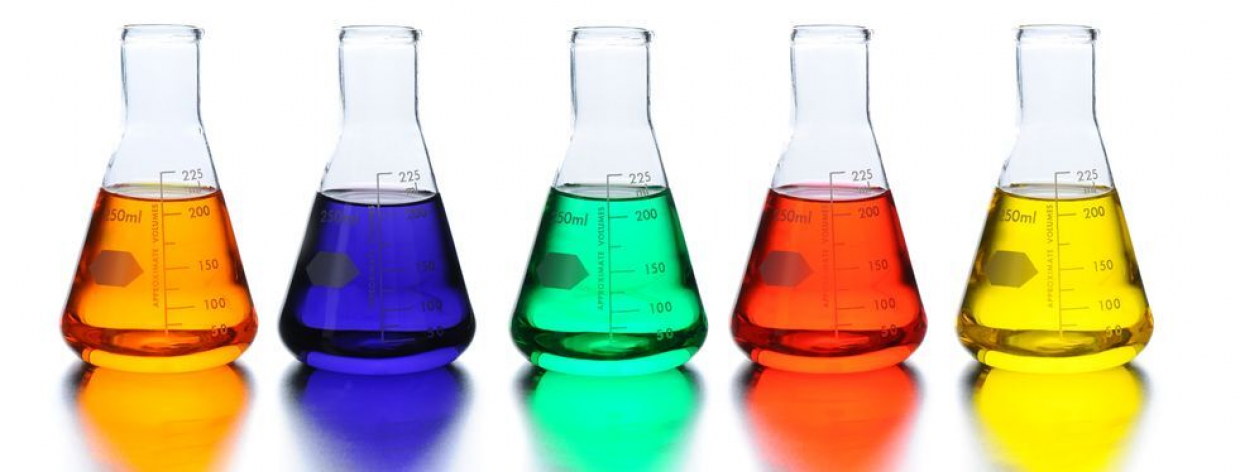

Our Products
Showing 1-20 of 20 products
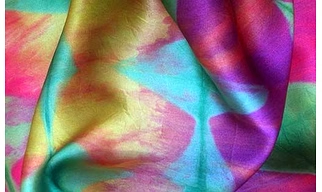
DIRECT DYES
Direct dyes are anionic dyes substantive to cellulosic fibers when applied from an aqueous bath containing electrolyte. Many of them also dye protein fibers.
Direct Dye is a class of dyestuffs that are applied directly to the substrate in a neutral or alkaline bath. They produce full shades on cotton and linen without mordanting and can also be applied to rayon, silk, and wool. Direct dyes give bright shades but exhibit poor wash fastness. Various after treatments are used to improve the wash fastness of direct dyes, and such dyes are referred to as “after treated direct colors.”Direct Dyes are molecules that adhere to the fabric molecules without help from other chemicals. Direct dyes are defined as anionic dyes with substantivity for cellulosic fibers, normally applied from an aqueous dyebath containing an electrolyte, either sodium chloride (NaCl) or sodium sulfate (Na2SO4).

SOLVENT DYES
A solvent dye is a dye soluble in organic solvents. It is usually used as a solution in an organic solvent.
Solvent dyes are used to color organic solvents, hydrocarbon fuels, waxes, lubricants, plastics, and other hydrocarbon-based nonpolar materials. Fuel dyes are one use of solvent dyes. Their molecules are typically nonpolar or little polar, and they do not undergo ionization. They are insoluble in water. They form a colloidal solution in solvents. They have poor (basic dyes) to good (metal complex based) light fastness.
Solvent dyes are used for gold imitation (and other transparent metallic effects) of metalized polyester films. Also used in marking inks, inkjet inks, glass coloration, and so on.
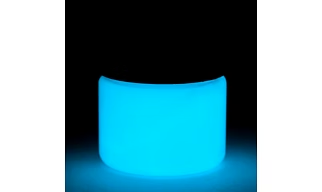
FLUORESCENT PIGMENTS
Daylight fluorescent pigments are luminescent materials that require no artificially generated energy to reflect colored light and give off fluorescent light. Fluorescent pigments are composed of dyed organic polymers that are formulated to be solvents for the fluorescent dyestuff. Fluorescent pigments are bright eye-catching powder colors. Fluorescent powder glow under UV light and gives eye catching appearance in the day light. Fluorescent pigments are also known as day glow fluorescent powder.
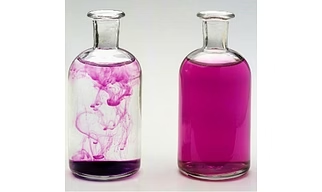
POTASSIUM PERMANGANATE
Potassium permanganate is a very strong oxidizing agent.
It's a deep red-violet metallic shiny crystalline solid. It can be dissolved in water to form a dark violet solution which is well suitable to bleach denim.
Potassium permanganate can be used for local bleaching by spraying application or for complete treatments in drum washing machines. The potassium permanganate solution must be mixed very well with the washing liquor, because of dissolved permanganate can cause different shades in only one bath.
Potassium per-manganate spray is done on jeans to take a bright effect on sand blast area. One important thing about potassium per-manganate spray is, this is usually a sporting process to increase the effect of sand blast. it is sprayed on blasted area of jeans garment with the help of normal spray gun.
ACID DYES
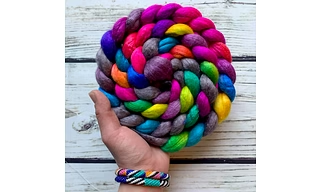
Acid dyes are highly water soluble, and have better light fastness than basic dyes. The textile acid dyes are effective for protein fibers such as silk, wool, nylon and modified acrylics. They contain sulphonic acid groups, which are usually present as sodium sulphonate salts. These increase solubility in water, and give the dye molecules a negative charge. In an acidic solution, the -NH2 functionalities of the fibres are protonated to give a positive charge: -NH3+. This charge interacts with the negative dye charge, allowing the formation of ionic interactions. As well as this, Van-der-Waals bonds, dipolar bonds and hydrogen bonds are formed between dye and fibre. As a group, acid dyes can be divided into two sub-groups: acid-leveling or acid-milling.
ACRYLIC DYES
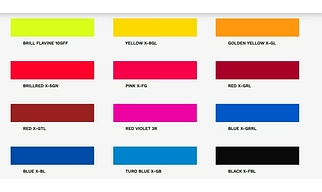
Acrylic (Cationic) Dyes are specially developed for dyeing Acrylic Fibre which is widely used in the manufacturing of Blankets, Carpets, Knitting Goods, Decorative Fabrics, Fur Toys, Dress Materials, Sarees, etc. These dyes are characterized by their strong tinctorial power, outstanding brightness and excellent fastness properties. They are also suitable for Dyeing and Printing which are free from German Banned Amines. They are water soluble mainly applied to acrylic fibres, but some use for wool and silk. Usually acetic acid is added to the dyebath to help the uptake of the dye onto the fibre.
PLASTISOL INKS
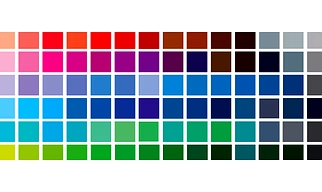
Plastisol inks are widely used in garment printing. They are easy to print, do not dry in the screen, can be very opaque on dark garments, and will adhere to most textiles. They are composed primarily of two ingredients, PVC resin (a white powder) and plasticizer (a thick, clear liquid). Plastisol inks have one outstanding characteristic; they must be heated to dry. They will not dry, or cure, at normal temperatures. For a complete cure, they must reach 290-330º F (143-166º C).
OT PASTE
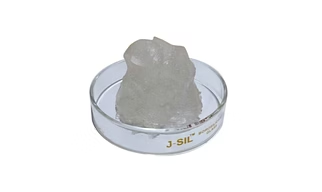
Wetting agent (OT Paste) used for textile industry. Dioctyl sodium sulfosuccinate as OT Paste is a white wax like solid with characteristic odor. It is sparingly soluble in water and freely soluble in alcohol, glycerol, Carbon tetrachloride, acetone xylene.
It saponification value varies from 240-253 and is stable in acid and neutral solution. it hydrolyzes in alkaline solution.
OT Paste is used as a wetting Agent in textile industries. OT Paste Wetting Agents is anionic product, thick paste, 0.5% of weight of cotton fiber or cloth instantaneously wets it. These products are used in various chemical industries and are highly demanded by our clients.
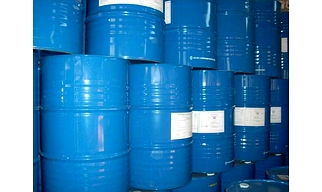
P.G. - PROPYLENE GLYCOL
Propylene glycol is a synthetic liquid substance that absorbs water. Propylene glycol is also used to make polyester compounds, and as a base for deicing solutions. Propylene glycol is used by the chemical, food, and pharmaceutical industries as an antifreeze when leakage might lead to contact with food.
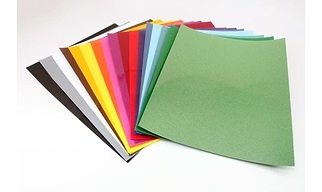
FLOCK POWDER
We are importer and supplier of flock powder in india since 1980,for textile,paper plastic and many application use,we have always 20 color ready in 0.4 to 2.5 mm size. Owing to our years of industry experience and precise knowledge in this domain, we are offering an outstanding assortment of Velvet Powder for velvet bindi, velvet gift items & to make velvet pencil.
KHADI / WHITE INK
Being one of the renowned firms in the industry, we are decidedly involved in providing a premium quality array of Stretch Khadi Chemicals. With our in-depth knowledge of this domain, we are actively engaged in offering an excellent quality assortment of Cotton Khadi Chemicals.
Stretch Khadi is an electrifying white ink used for fast and soft printing on Polyester, Nylon, Acrylic, Silk, Cellulosic and blended fabrics. The offered product is processed and formulated as per the set industry norms using pioneering procedures and premium grade chemical compounds at our advanced unit. Our given product is highly acknowledged for its accurate composition and long shelf life. The offered Stretch Khadi is stringently checked against different predefined parameters in order to ensure quality and flawlessness. Highly effective, long shelf life and balanced composition are qualities of offered product.

PEARL POWDER
Pearl powder is made by boiling fresh or saltwater pearls (to sterilize them), and then milling the pearls into a soft fine powder that’s similar in texture to flour or cornstarch. It contains amino acids, calcium, and trace minerals and has many purported benefits for skin and health. It is a popular ingredient in skin care products today, but it isn’t new. It’s been used for thousands of years in Chinese and Ayurvedic medicine.
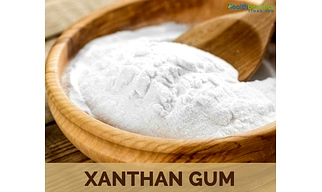
XANTHAN GUM
Xanthan Gum is a high molecular weight polysaccharide, produced through the fermentation of carbohydrates such as corn, using a microbe called xanthomonas campestris. Xanthan gum’s unique molecular structure imparts special functional characteristics in aqueous systems, such as stabilizing and thickening, suspending, rheology modification, bonding and foam enhancement. Xanthan gum is a widely used GRAS food ingredient, with proven functionality and safety in a wide range of food and beverage products, offering these characteristics:
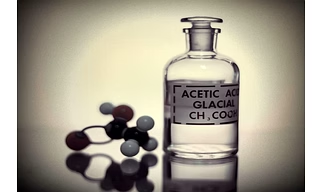
ACETIC ACID
Acetic Acid is an organic compound with the chemical formula CH3COOH. which when diluted is also called Glacial Acetic Acid. Acetic Acid is the main component of vinegar (apart from water), and has a distinctive sour taste and pungent smell. Although it is classified as a weak Acid, concentrated acetic Acid is corrosive, and attacks the skin.
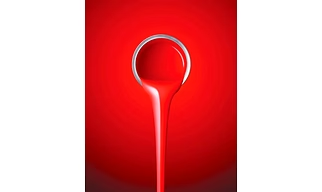
WATER BASED FLEXOGRAPHIC INKS
To ensure high standard quality production and customer satisfaction, A new-generation Water Based Flexographic Inks have been introduced by us, to switch from solvent based inks. We aim to develop best Printing Inks, which are being manufactured by using quality assured base materials that focuses on the flawlessness and quality attributes of our products and that can successfully meet the changing industrial requirement
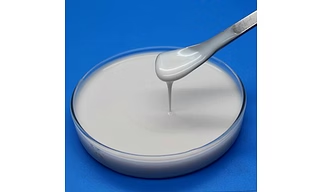
WATER THICKENER
A thickening agent or thickener is a substance which can increase the viscosity of a liquid without substantially changing its other properties. Edible thickeners are commonly used to thicken sauces, soups, and puddings without altering their taste; thickeners are also used in paints, inks, explosives, and cosmetics.
Thickeners may also improve the suspension of other ingredients or emulsions which increases the stability of the product. Thickening agents are often regulated as food additives and as cosmetics and personal hygiene product ingredients. Some thickening agents are gelling agents (gellants), forming a gel, dissolving in the liquid phase as a colloid mixture that forms a weakly cohesive internal structure. Others act as mechanical thixotropic additives with discrete particles adhering or interlocking to resist strain.
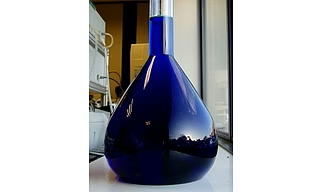
BASIC DYES
Basic dye is a stain that is cationic (+ve charged) and so will react with material that is (-ve) negatively charged. This dye is usually synthetic, that act as bases, and which are actually aniline dyes. Their color base is not water soluble but can be made so by converting the base into a salt. The basic dyes, while possessing great tinctorial strength and brightness, are not generally light-fast.
Basic (or cationic) dye molecules have a coloured component carrying a positive electrical charge which is attracted by negative charges on the fibre. Basic dyes must not be: (i) mixed with the negatively charged acid dyes since they will neutralise each other to form an insoluble complex; or (ii) used under alkaline conditions since many of the dyes will decompose to form the colourless dye base which is insoluble in water.
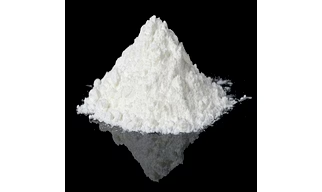
TITANIUM DIOXIDE
Titanium dioxide (TiO2) is a bright white substance used primarily as a vivid colorant in a wide array of common products. It also has a number of lesser-known qualities that make it an extremely useful and important ingredient in our battle to fight climate change and prevent skin cancer.
Prized for its ultra-white color, ability to scatter light and UV-resistance, TiO2 is a popular ingredient, appearing in hundreds of products we see and use every day, bringing significant benefits to our economy and overall quality of life.
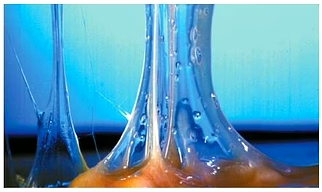
FABRIC ADHESIVES
Laminates of fabrics, and fabrics with other substrates, are a recent development in the long history of fibers, textiles and fabrics. Woven cloth has been known since antiquity; fabric laminations have become widely used only in the past forty years—with the development of synthetic fibers and the adhesives needed to provide functional bonding.
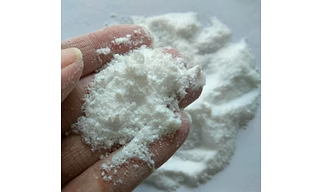
GUAR GUM
Guar gum is a novel agrochemical processed from endosperm of cluster bean. It is largely used in the form of guar gum powder as an additive in food, pharmaceuticals, paper, textile, explosive, oil well drilling and cosmetics industry. Industrial applications of guar gum are possible because of its ability to form hydrogen bonding with water molecule. Thus, it is chiefly used as thickener and stabilizer. It is also beneficial in the control of many health problems like diabetes, bowel movements, heart disease and colon cancer. This article focuses on production, processing, composition, properties, food applications and health benefits of guar gum.
Guar gum, also called guaran, is a galactomannan polysaccharide extracted from guar beans that has thickening and stabilizing properties useful in food, feed, and industrial applications. The guar seeds are mechanically dehusked, hydrated, milled and screened according to application.


 GL Trustmark