Inclusive of all taxes
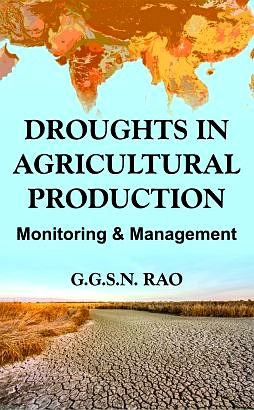
The hardback book, 'Droughts in Agricultural Production: Monitoring & Management' by G.G.S.N. Rao provides a comprehensive examination of drought as a climatic phenomenon, particularly emphasizing its implications on agricultural productivity. It outlines the historical prevalence of droughts and famines in India, providing important context to understanding drought in both historical and contemporary settings. Readers will gain insight into the classification of droughts, as well as the indices used to measure their severity, based on rainfall data, climate derivatives, and advanced remote sensing techniques. The book discusses the significant role climate change plays in exacerbating drought conditions, presenting scientific projections on temperature and rainfall trends at both global and national levels. Additionally, the text delves into effective drought monitoring strategies employed worldwide, showcasing decision support systems and the application of Geographic Information Systems (GIS) for real-time tracking of drought conditions. With emphasis on food production variability and specific impacts on livestock, milk production, and fisheries, it further explores the interplay between global surface water resources and drought effects. The exploration of indigenous knowledge systems and traditional drought management techniques from nomadic communities in Asia and Africa provides culturally relevant insights. This book is an essential resource for students, researchers, and scientists in agrometeorology, meteorology, and geography, as well as any professional engaged in natural resource management (NRM).
Key Features
| Features | Description |
|---|---|
| Author | G.G.S.N. Rao |
| Format | Hardback |
| Target Audience | Students and Research Scholars in Agrometeorology, Meteorology, Geography, and Research Scientists involved with NRM |
| Content Coverage | Historical background, Climate change impacts, Drought Monitoring Strategies, Indigenous drought management practices |
| Unique Selling Proposition | Integrates scientific insights with traditional knowledge for a well-rounded approach to drought management. |
| Attributes | Description |
|---|---|
| ISBN | 978-XXXXXXX-XX-X |
| Number of Pages | XX |
| Publisher | XXXX Publishers |
| Publication Year | 20XX |
| Language | English |
*Disclaimer: The above description has been AI-generated and has not been audited or verified for accuracy. It is recommended to verify product details independently before making any purchasing decisions.
The book covers the historical context of droughts, their classification, climate change impacts, monitoring strategies, implications for agricultural production, and management techniques employed globally.
It provides projections of temperature and rainfall changes, discusses the consequences of climate change on droughts, and examines international cooperation in drought monitoring.
Students and research scholars in agrometeorology, meteorology, geography, as well as research scientists working in natural resource management and related fields will find this book highly beneficial.
The book integrates indigenous knowledge and traditional wisdom prevalent in nomadic communities in Asia and Africa, offering a culturally rich perspective on drought management.
Yes, the book explores decision support systems and Geographic Information Systems (GIS) for effective drought monitoring strategies.
Brand: nipa
Country Of Origin: India
Drought is considered to be a normal feature of climate especially in tropical countries where occurrence of periods of dry weather during rainy season is common. Virtually droughts can occur in all climates and they can also be witnessed when the air temperatures are higher than the normal for a longer period that increases both evaporation and water deficit.
1. The first deals with the introduction to the topic, historical evidences of drought and famines in India. 2. The definition of droughts, criteria for classification of droughts, drought indices based on rainfall, climate derivatives and remote sensing are covered under two. 3. Information on climate change with respects to climate trends, projections on temperature and rainfall at global as well at national level, consequences of climate change on droughts are presented in there.
Drought is considered to be a normal feature of climate especially in tropical countries where occurrence of periods of dry weather during rainy season is common. Virtually droughts can occur in all climates and they can also be witnessed when the air temperatures are higher than the normal for a longer period that increases both evaporation and water deficit.
1. The first deals with the introduction to the topic, historical evidences of drought and famines in India. 2. The definition of droughts, criteria for classification of droughts, drought indices based on rainfall, climate derivatives and remote sensing are covered under two. 3. Information on climate change with respects to climate trends, projections on temperature and rainfall at global as well at national level, consequences of climate change on droughts are presented in there. 4. Approaches on drought monitoring, adopted by various countries, international cooperation in drought monitoring and drought monitoring mechanism in India are presented in four. Decision Support Systems and applications of GIS for drought monitoring are also covered in this . 5. World food production and its variability, the impact of phenomenal drought during 2009 on food grain production in different countries, impacts of droughts on livestock, milk and fisheries production are covered under five. 6. Global surface waters, availability of surface waters in India, influence of drought on fauna and flora of surface waters and global warming on water resources at global and national level is discussed in six. 7. Drought management strategies, drought planning and preparedness action plans at global as well at national level, indigenous knowledge on drought management, astrological techniques in weather forecasting and traditional wisdom on management of droughts in different nomadic communities in Asia and Africa are covered in seven. eight carries the conclusion of the entire book.
Book will be useful to the students and research scholars of Agrometeorology, Meteorology and Geography and all Research Scientists dealing with NRM.
Content
1. Introduction 2. Drought Assessment and Vulnerability 3. Climate Change and Droughts 4. Drought Monitoring 5. Impacts on Agricultural Production 6. Impacts on Water Resources 7. Drought Management Strategies 8. Conclusions
Inclusive of all taxes
You Save: 0
North Delhi , India
Service Provider , Manufacturer, Professional Services, Brand Owner, Distributor, Exporter, Importer, Wholesaler, Startup