

 FIEO Registered
Our Products
Showing 1-6 of 6 products

Dead Plug
A dead plug, or dummy plug, is a non-functional connector used to cover unused ports or sockets. It serves to protect equipment by preventing dust, moisture, and debris from entering, while also ensuring safety by blocking access to exposed electrical contacts. Dead plugs are commonly used in various environments, including industrial settings, to maintain equipment integrity and prolong its lifespan.
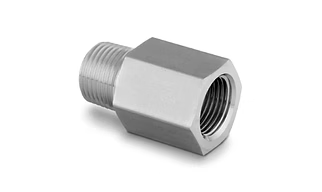
Adapter
An adapter fitting is a component used in piping and plumbing systems to connect two different types of fittings or pipes that may have differing sizes, threads, or materials. It ensures compatibility between various system components without needing to modify the existing setup. Adapter fittings are commonly used in applications such as fluid handling, gas lines, and mechanical systems.
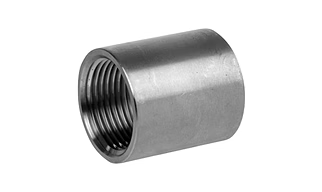
Pipe Coupling
A pipe coupling is a short fitting used to connect two pipes in a plumbing, piping, or gas system, allowing for the extension or repair of pipelines. It provides a secure, leak-proof connection between pipes, ensuring fluid or gas can flow smoothly through the system.
Types of Pipe Couplings:
1. Full Coupling: Connects two pipes of the same size.
2. Half Coupling: Connects a pipe to a fitting or piece of equipment.
3. Reducer Coupling: Joins pipes of different diameters.
4. Slip Coupling: Allows pipe sections to be joined without needing to thread the ends.
5. Compression Coupling: Uses a rubber gasket or seal to compress and secure the connection, often used for repairs.
Materials: Pipe couplings can be made from materials such as steel, brass, copper, PVC, or stainless steel, depending on the system's requirements and the fluids being transported.
Pipe couplings are vital in maintaining the integrity of piping systems, allowing for flexibility in installation, repair, and extension of pipe networks.
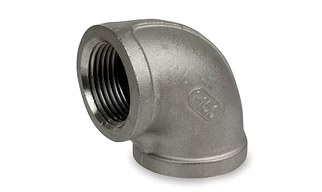
Elbow
An elbow fitting is a pipe fitting used to change the direction of flow in a piping system, typically by 90 or 45 degrees. It is essential for routing pipelines around obstacles or for changing the orientation of the piping layout.
Types of Elbow Fittings:
1. 90-degree elbow: Turns the pipe at a right angle.
2. 45-degree elbow: Creates a gentler turn.
3. Reducing elbow: Changes both direction and pipe size.
4. Street elbow: One end has male threads, and the other has female threads, allowing for direct connection without additional fittings.
Materials: Elbows can be made from materials such as steel, copper, brass, PVC, or stainless steel, depending on the application and the type of fluid or gas being transported.
Applications: Elbow fittings are widely used in plumbing, HVAC systems, irrigation, and industrial piping to guide fluid flow efficiently while minimizing pressure loss or turbulence.
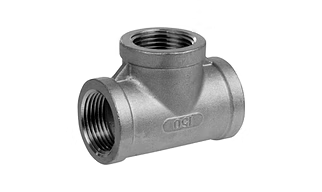
Tee fitting
A tee fitting is a pipe fitting shaped like the letter "T" that is used to combine or split fluid or gas flow in a piping system. It has three openings, with two outlets positioned at a 90-degree angle from the main line. Tee fittings allow the redirection of flow, the addition of branches, or the mixing of fluids.
Types of Tee Fittings:
1. Equal Tee: All three outlets have the same diameter, used to split or combine flow evenly.
2. Reducing Tee: One outlet is smaller in diameter, used to connect pipes of different sizes.
3. Branch Tee: Diverts flow from the main pipe to a branch at a 90-degree angle.
Materials: Common materials include stainless steel, copper, brass, PVC, and galvanized steel, selected based on the system’s requirements and the type of fluid being transported.
Applications: Tee fittings are widely used in plumbing, irrigation, gas distribution, and industrial piping systems for creating branches, distributing flow to multiple points, or integrating additional equipment.
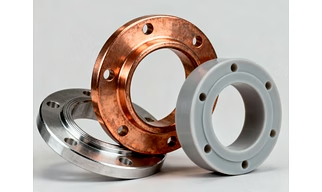
Flanges
A flange is a component used to connect pipes, valves, pumps, and other equipment in piping systems, providing easy assembly, disassembly, and maintenance. Flanges are typically bolted together and sealed with gaskets to ensure a leak-proof connection.
Types of Flanges:
1. Weld Neck Flange: Designed to be welded to the pipe, providing strength and reducing stress.
2. Slip-On Flange: Slides over the pipe and is welded at both ends for a secure connection.
3. Blind Flange: Used to close off the end of a pipe or valve opening.
4. Socket Weld Flange: Used for smaller, high-pressure pipes, with the pipe inserted into the flange before welding.
5. Lap Joint Flange: Paired with a stub end for easy alignment and assembly, commonly used in systems requiring frequent disassembly.
6. Threaded Flange: Screws onto pipes with external threads, ideal for low-pressure applications or where welding isn’t feasible.
Materials: Flanges can be made from stainless steel, carbon steel, aluminum, brass, PVC, or other materials based on the application and the substances being transported.
Applications: Flanges are widely used in industrial piping, oil and gas, water treatment, chemical processing, and HVAC systems to connect equipment, isolate sections, or allow easy access for inspection and repair.

 GL Trustmark