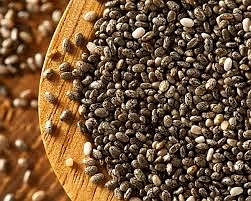
White Quinoa (Chenopodium quinoa) is a premium, highly nutritious seed renowned for its versatile usage in both culinary and industrial applications. This white variety features small, round to oval seeds approximately 2-4 mm in diameter. White quinoa is prized for its mild flavor and high nutritional profile, including all nine essential amino acids, making it a complete protein source. The seeds have a natural saponin coating, which is typically removed during preprocessing to reduce bitterness, ensuring a pleasant taste and enhanced usability. Rich in dietary fiber, proteins, vitamins (B-complex and Vitamin E), and minerals such as iron, magnesium, and phosphorus, white quinoa suits health-conscious food formulations and functional food products. It is frequently used as a gluten-free grain substitute in salads, soups, side dishes, baking, and processed foods for specialized nutrition markets. The processing options include whole seeds, flour, flakes, and pre-cooked forms that cater to various industrial requirements. Its botanical classification under the Amaranthaceae family and Chenopodium genus ensures authenticity and quality assurance.
Key Features
| Features | Description |
|---|---|
| Scientific Name | Chenopodium quinoa |
| Seed Size | 2-4 mm diameter |
| Seed Shape | Round to oval |
| Seed Color | White |
| Protein Content | 4-5 g per 100g cooked |
| Complete Protein | Contains all nine essential amino acids |
| Dietary Fiber | 2.8-3.0 g per 100g cooked |
| Saponin Content | Natural coating, typically removed by rinsing |
| Minerals | Iron (1.5-2.0 mg), Magnesium (64-118 mg), Phosphorus (152-281 mg), Zinc (1.1-2.0 mg) |
| Available Forms | Whole seeds, flour, flakes, pre-cooked forms |
| Attributes | Description |
|---|---|
| Botanical Family | Amaranthaceae |
| Genus | Chenopodium |
| Calories (per 100g cooked) | 120-130 kcal |
| Fat Content | 1.9-2.3 g (Saturated fat 0.2-0.4 g) |
| Carbohydrates | 21-22 g |
| Sugars | 0.9-1.2 g |
| Vitamins | Vitamin B1, B2, B6, Folate, Vitamin E |
| Phytochemicals | Quercetin, Kaempferol |
| Processing Instructions | Rinse seeds to remove saponins before cooking |
| Cooking Method | Boil with water in 2:1 ratio for 15 minutes |
*Disclaimer: The above description has been AI-generated and has not been audited or verified for accuracy. It is recommended to verify product details independently before making any purchasing decisions.
The natural saponin coating on White Quinoa seeds is typically removed by rinsing the seeds thoroughly with water prior to cooking or processing.
White Quinoa is available in whole seed form, as flour, flakes, and pre-cooked variants for various food manufacturing and industrial applications.
White Quinoa is a complete protein source containing all nine essential amino acids, which is uncommon among grains, making it a superior protein option.
Yes, White Quinoa is naturally gluten-free and widely used in manufacturing gluten-free foods and health-oriented dietary products.
White Quinoa seeds should be cooked by boiling in water with a 2:1 water-to-quinoa ratio, typically for about 15 minutes, after rinsing to remove saponins.
Quinoa is a highly versatile and nutritious seed that is often classified as a grain. Here are the technical specifications and key characteristics of quinoa:
Botanical Information
• Scientific Name: Chenopodium quinoa
• Family: Amaranthaceae
• Genus: Chenopodium
Physical Characteristics
• Seed Size: Approximately 2-4 mm in diameter.
• Seed Shape: Round to oval.
• Color: Typically ranges from white, red, to black.
• Seed Coat: Contains a natural saponin coating that can be bitter; usually removed through processing.
Nutritional Composition (per 100g of cooked quinoa)
• Calories: 120-130 kcal
• Protein: 4-5 g
• Fat: 1.9-2.3 g
o Saturated Fat: 0.2-0.4 g
o Monounsaturated Fat: 0.8-1.0 g
o Polyunsaturated Fat: 0.8-1.1 g
• Carbohydrates: 21-22 g
o Dietary Fiber: 2.8-3.0 g
o Sugars: 0.9-1.2 g
• Minerals:
o Iron: 1.5-2.0 mg
o Magnesium: 64-118 mg
o Phosphorus: 152-281 mg
o Potassium: 118-118 mg
o Zinc: 1.1-2.0 mg
• Vitamins:
o Vitamin B1 (Thiamine): 0.1-0.2 mg
o Vitamin B2 (Riboflavin): 0.2 mg
o Vitamin B6: 0.1-0.2 mg
o Folate: 42-78 µg
o Vitamin E: 0.6-0.7 mg
Chemical Properties
• Protein Quality: Contains all nine essential amino acids, making it a complete protein source.
• Saponins: Present in the outer seed coat; responsible for a bitter taste; usually removed by rinsing.
• Phytochemical Compounds: Includes flavonoids like quercetin and kaempferol.
Processing
• Preparation: Seeds should be rinsed before cooking to remove saponins. Can be cooked in boiling water (2:1 ratio of water to quinoa) for about 15 minutes.
• Forms: Available as whole seeds, flour, flakes, and in pre-cooked or processed forms.
Applications
• Culinary Uses: Used as a grain substitute, in salads, soups, side dishes, and baking.
• Industrial Uses: Employed in health foods, gluten-free products, and as an ingredient in various processed foods.
Inclusive of all taxes
You Save: 0
Mumbai , India
Service Provider , Manufacturer, Professional Services, Exporter, Importer, Wholesaler, Women Entrepreneur, Startup
GST- 36BEMPR8057R1ZA