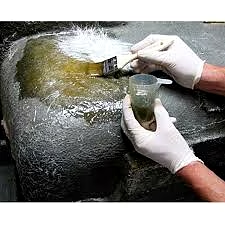
Our Unsaturated Polyester Resin (UPR) range includes orthophthalic resin, isophthalate resin, terephthalic resin, and bisphenol resin, tailored for high-performance industrial applications. These resins are synthesized through the precise reaction between difunctional acids or anhydrides such as maleic, fumaric, phthalic, isophthalic, or terephthalic acids, and difunctional glycols including monethylene glycol, diethylene glycol, propylene glycol, and neopentyl glycol. The resulting polyester polymer is then blended with reactive monomers such as styrene or methyl methacrylate to form a versatile unsaturated polyester resin system, with a typical styrene content ranging between 30 to 50 weight percent. The UPR undergoes a controlled cross-linking reaction when catalyzed by methyl ethyl ketone peroxide (MEKPO) and accelerated by cobalt octoate, transforming from a liquid state to a solid three-dimensional matrix ideal for molding and casting. Our UPRs are widely used in manufacturing Fiber Reinforced Plastic (FRP) composites, including corrosion-resistant FRP linings, FRP tanks, recreational products, and FRP boats owing to their superior mechanical strength, chemical resistance, and durability. To ensure prolonged shelf life and maintain consistent quality, inhibitors such as hydroquinone and p-tert-butylcatechol (p-TBC) are incorporated during production. Our Unsaturated Polyester Resins undergo stringent quality control measures to guarantee flawless performance, making them trusted raw materials for FRP manufacturing industries seeking reliability and excellence in composite solutions.
Key Features
| Features | Description |
|---|---|
| Resin Types | Orthophthalic, Isophthalate, Terephthalic, Bisphenol resins |
| Raw Material Reaction | Difunctional acid/anhydride and difunctional glycol polymerization |
| Reactive Monomers | Styrene monomer, methyl methacrylate, others |
| Styrene Content | 30-50 weight % |
| Catalyst System | Methyl ethyl ketone peroxide (MEKPO) and cobalt octoate accelerator |
| Cross-linking Reaction | Transforms liquid resin to solid three-dimensional matrix |
| Typical Applications | FRP Tanks, FRP Boats, recreational items, corrosion resistant linings |
| Shelf Life Enhancers | Inhibitors like hydroquinone and p-tert-butylcatechol (p-TBC) |
| Quality Control | Rigorous testing ensures flawless dispatch and performance |
| Attributes | Description |
|---|---|
| Polymerization Components | Difunctional acids (maleic, fumaric, phthalic, isophthalic, terephthalic), Difunctional glycols (monethylene glycol, diethylene glycol, propylene glycol, neopentyl glycol) |
| Monomer Content | Styrene typically 30-50% by weight |
| Catalysts | Methyl ethyl ketone peroxide (MEKPO) |
| Accelerator | Cobalt octoate |
| Inhibitors | Hydroquinone, p-tert-butylcatechol (p-TBC) |
| Physical State | Liquid prior to curing, solid after cross-linking |
| Chemical Type | Unsaturated polyester thermosetting resin |
| Cross-linking Mechanism | Free radical initiated polymerization |
| End-use Industries | Composite manufacturing for corrosion resistance, marine, recreational products |
| Quality Assurance | Batch-wise rigorous testing for chemical composition and curing performance |
*Disclaimer: The above description has been AI-generated and has not been audited or verified for accuracy. It is recommended to verify product details independently before making any purchasing decisions.
Our UPR formulations are produced by reacting difunctional acids or anhydrides like maleic, fumaric, phthalic, isophthalic, and terephthalic acids with difunctional glycols such as monethylene glycol, diethylene glycol, propylene glycol, and neopentyl glycol.
Styrene content, which ranges from 30 to 50 weight percent in our UPRs, acts as a reactive diluent, influencing viscosity, curing rate, mechanical properties, and final hardness of the polyester resin.
We use methyl ethyl ketone peroxide (MEKPO) as the catalyst and cobalt octoate as the accelerator to initiate the cross-linking free radical polymerization, ensuring efficient curing from liquid to solid phase.
Inhibitors such as hydroquinone and p-tert-butylcatechol (p-TBC) are incorporated to inhibit premature polymerization during storage, thereby extending the shelf life of the unsaturated polyester resins.
Our UPRs are primarily used in industries manufacturing fiber reinforced plastic (FRP) products including tanks, boats, recreational composites, and corrosion-resistant linings.
Each batch undergoes rigorous quality control testing by our expert team, focusing on chemical composition, viscosity, curing behavior, and final mechanical properties to ensure flawless performance.
Country Of Origin: India
Our range of upr includes: orthophthalic resin, isophthalate resin, terephthalic resin and bisphenol resin. it is formed by reaction between a difunctional acid or anhydride (e.g. Maleic, fumaric, phthalic, isophthalic, terephthalic) and a defunctional glycol (e.g. Monethylene glycol, diethyene glycols, propylene glycols, neopentyl glycol). This reaction mixture is blended/dissolved with reactive monomer (e.g. Styrene monomer) mono meth acrylate or any other) to constitute unsaturated polyester resin system. the commercial polyester system has a styrene content of about 30- 50 weight % the heat of reaction which is triggered by the interaction of the reaction with the catalyst (methyl ethyl ketone peroxide- mekpo) and accelerator (promoter) cobalt octoate. It results in the cross linking reaction leading to transformation from the liquid state to upr to solid state to form the three dimensional matrix (cast).
UPR is generally used to make composites like FRP Tanks, recreational items, FRP Boats, corrosion resistant FRP lining.
Inhibitors like hydroquinone, p-tbc are used to extend the shelf life of upr during the storage.
We are one of the trusted companies of FRP Raw materials. Our products are enormously admired in the market owing to their top features.
The offered products are rigorously examined by the team of our quality experts to insure flawless dispatch.
Stay informed with the latest market trends, quality guides, and industry analysis