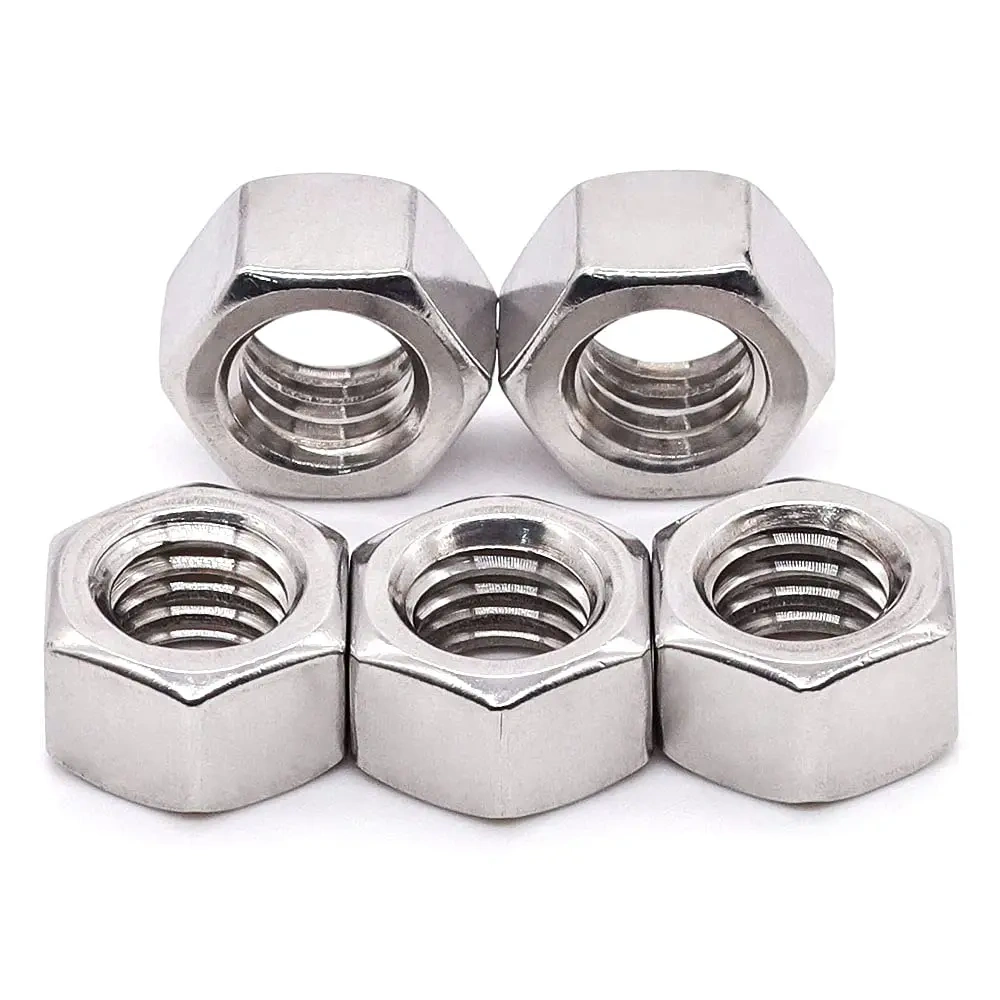
<h3>Stainless Steel Nut by VSI</h3> <p>Welcome to an in-depth overview of the versatile and high-quality Stainless Steel Nut provided by VSI. These nuts are designed to meet the demanding requirements of various industries and applications. Let's dive into the extensive details, technical specifics, and diverse applications of these robust nuts.</p> <h3>Types of Stainless Steel Grades</h3> <h4>Grade 304 Stainless Steel</h4> <ul> <li><strong>Composition:</strong> 18% Chromium, 8% Nickel</li> <li><strong>Application:</strong> General-purpose applications</li> <li><strong>Properties:</strong> High corrosion resistance, exceptional durability, and resistance to oxidation. Ideal for indoor and outdoor environments.</li> </ul> <h4>Grade 316 Stainless Steel</h4> <ul> <li><strong>Composition:</strong> 16% Chromium, 10% Nickel, 2% Molybdenum</li> <li><strong>Application:</strong> Corrosive and high-temperature environments</li> <li><strong>Properties:</strong> Superior corrosion resistance, especially against chlorides and acids. Enhanced resistance to pitting and crevice corrosion. Suitable for marine and chemical processing industries.</li> </ul> <h3>Key Features</h3> <ol> <li><strong>Corrosion Resistance</strong>: Both 304 and 316 grades offer exceptional resistance to rust and corrosion, making them suitable for use in harsh and extreme environments.</li> <li><strong>Strength and Durability</strong>: Engineered to provide unmatched strength and long-lasting performance in various settings.</li> <li><strong>Versatility</strong>: Widely used in multiple industries, from automotive to aerospace and everything in between.</li> <li><strong>Ease of Use</strong>: Designed for easy installation, fastening, and unfastening to accommodate both permanent and temporary fixtures.</li> </ol> <h3>Applications</h3> <h4>Automotive Industry</h4> <p>Stainless steel nuts are indispensable in the automotive sector for their ability to withstand high temperatures and corrosive environments. They are used in: - Engine assemblies - Exhaust systems - Transmission units - Chassis and frame construction</p> <h4>Construction Industry</h4> <p>In the construction industry, stainless steel nuts provide reliable fastening solutions for: - Steel frameworks - Bridges - Tunnels - Building facades - General structural applications</p> <h4>Marine Industry</h4> <p>The marine industry benefits from the high corrosion resistance of 316-grade stainless steel nuts, which are used in: - Boat fittings - Offshore drilling rigs - Marine hardware - Submersible pumps</p> <h4>Aerospace Industry</h4> <p>Aerospace applications demand the highest precision and performance, and stainless steel nuts are utilized in: - Aircraft structures - Engine components - Landing gear assemblies - Satellite technology</p> <h4>Chemical Processing</h4> <p>The chemical processing industry relies on the superior resistance of 316 stainless steel nuts to handle: - Pipe fittings - Reactor vessels - Heat exchangers - Storage tanks</p> <h3>Types of Stainless Steel Nuts</h3> <h4>Hex Nuts</h4> <p>The most common type of stainless steel nuts, hex nuts, are known for their versatility and prevalent use in various industries. Characteristics include: - <strong>Design</strong>: Six-sided, providing a strong grip and ease of wrenching. - <strong>Applications</strong>: Structural frameworks, machinery, and equipment assemblies.</p> <h4>Wing Nuts</h4> <p>Wing nuts are specialized fasteners that allow for frequent and tool-free fastening. Characteristics include: - <strong>Design</strong>: Features protruding ‘wings’ for hand tightening and loosening. - <strong>Applications</strong>: Pipe fittings, temporary structures, and machinery requiring frequent adjustments.</p> <h3>Technical Specifications</h3> <p>| Specification | Grade 304 | Grade 316 | |-------------------|---------------------------------------------|-----------------------------------------------| | Chromium Content | 18% | 16% | | Nickel Content | 8% | 10% | | Molybdenum Content| N/A | 2% | | Corrosion Resistance | High | Very High | | Temperature Resistance | Up to 870°C (1598°F) | Up to 870°C (1598°F) | | Tensile Strength | Up to 621 MPa (90 ksi) | Up to 579 MPa (84 ksi) | | Yield Strength | Up to 290 MPa (42 ksi) | Up to 241 MPa (35 ksi) | | Hardness | Up to 95 HRB | Up to 95 HRB | | Applications | General purpose | Marine, chemical, and high-temperature environments |</p> <h3>Detailed Characteristics</h3> <h4>Corrosion Mechanisms</h4> <p>Stainless steel nuts combat corrosion through the formation of a passive chromium oxide layer on their surface. This layer acts as a protective barrier, preventing further oxidation and enhancing lifespan.</p> <h4>Mechanical Properties</h4> <p>Both 304 and 316 grades exhibit excellent mechanical properties. The addition of molybdenum in 316-grade enhances its strength and makes it more suited for high-load applications. These nuts maintain structural integrity under stress and adapt to various load conditions.</p> <h4>Temperature Constraints</h4> <p>304 and 316 stainless steel nuts can perform effectively at high temperatures, making them suitable for engines, exhaust systems, and other high-temperature applications. Their ability to resist scaling and maintain mechanical properties</p>
*Disclaimer: The above description has been AI-generated and has not been audited or verified for accuracy. It is recommended to verify product details independently before making any purchasing decisions.
For nuts and bolts, the most common grades are 304 and 316. Grade 304 contains 18% chromium and 8% nickel and is ideal for general-purpose applications. Grade 316 contains 16% chromium, 10% nickel, and 2% molybdenum and is suitable for corrosive and high-temperature environments.
These Nuts find versatile applications across various industries such as automotive, construction, marine, and aerospace. They serve as a popular choice in extreme temperature or harsh environments, including lubricated machinery, chemical processing, offshore drilling, and more.
The most commonly used type of stainless steel nuts are Hex nuts, which find widespread applications in industries such as automotive and construction. In contrast, Wing nuts come in handy in applications where frequent fastening and unfastening is required, such as pipe fittings.