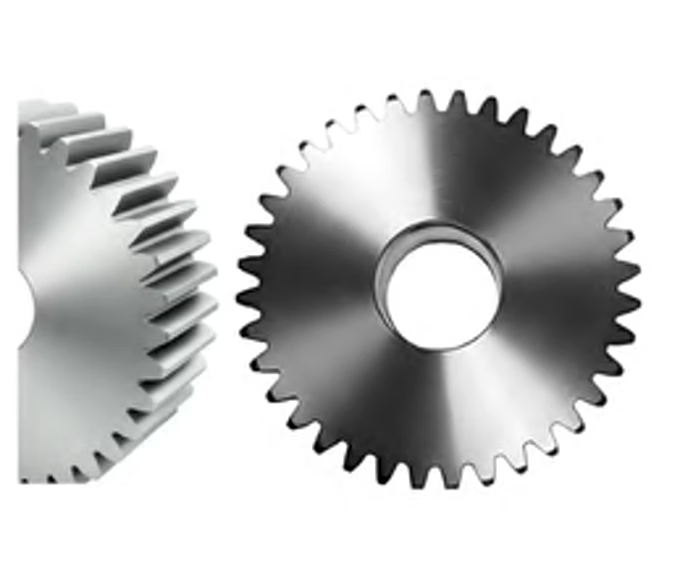
Helical gears are precision-engineered mechanical components featuring teeth cut at an angle to the gear's axis of rotation, creating a helical or spiral tooth profile. This unique design allows for smoother and quieter operation compared to spur gears by enabling gradual engagement of teeth during rotation, which reduces vibration and noise levels. Ideal for transmitting power and motion between parallel or slightly offset shafts, helical gears are widely used in various industrial applications including automotive transmissions, conveyors, robotics, and heavy machinery. Their angled teeth facilitate higher load capacity and increased torque transmission, enhancing overall gear efficiency and durability. Constructed from high-strength materials such as alloy steel, these gears are engineered for high performance, wear resistance, and long service life, making them an optimal choice for demanding B2B industrial environments requiring reliable and efficient power transmission solutions.
Key Features
| Features | Description |
|---|---|
| Tooth Design | Angled teeth forming a helical path |
| Operation | Smooth and quiet due to gradual tooth engagement |
| Load Capacity | Higher load capacity than spur gears |
| Application | Used for parallel or slightly offset shaft power transmission |
| Material | Manufactured from high-strength alloy steel or similar materials |
| Durability | High wear resistance and long service life |
| Torque Transmission | Capable of transmitting higher torque efficiently |
| Noise Reduction | Reduced vibration and noise levels during operation |
| Attributes | Description |
|---|---|
| Pressure Angle | Typically 20° |
| Helix Angle | Varies between 15° to 30° depending on design |
| Module (Gear Size) | Customizable per requirement |
| Face Width | Dependent on application and load requirements |
| Material Grade | Alloy Steel (e.g., SAE 8620, 4140) |
| Heat Treatment | Carburizing or induction hardened for increased surface strength |
| Surface Finish | Precision ground or cut for optimal meshing |
| Mounting Type | Compatible with shaft assemblies – keyway or splined |
*Disclaimer: The above description has been AI-generated and has not been audited or verified for accuracy. It is recommended to verify product details independently before making any purchasing decisions.
Helical gears provide smoother and quieter operation by engaging teeth gradually, offer higher load capacity, can handle greater torque, and reduce vibration compared to spur gears, making them more suitable for heavy-duty and high-speed applications.
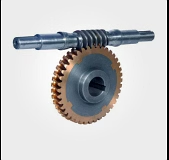
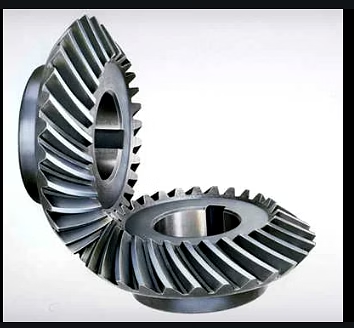
Helical gears are primarily designed for parallel or slightly offset shafts; for non-parallel shafts, bevel or worm gears are more suitable.
Helical gears are commonly made from high-strength alloy steels such as SAE 8620 or 4140, often heat-treated through carburizing or induction hardening processes to enhance surface hardness and wear resistance.
The helix angle influences the smoothness of engagement, load distribution, and sliding action; higher helix angles provide smoother operation but increase axial thrust and manufacturing complexity.
Yes, helical gears can be customized in terms of module, face width, helix angle, material, and heat treatment to meet the precise needs of different industrial applications.
Country Of Origin: India
Helical gear is a type of mechanical gear whose teeth are cut at an angle to its axis of rotation, forming a helical path