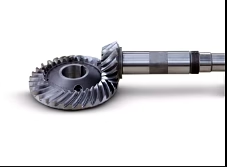
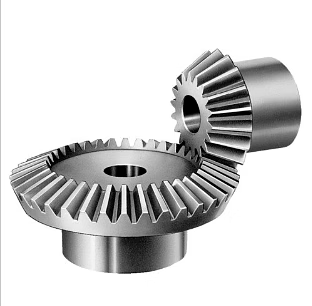
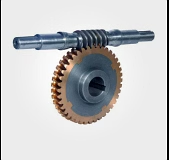
Worm shafts are precision-engineered mechanical components designed specifically for use in worm gear assemblies. These shafts are characterized by a helical thread formation that meshes with a worm gear, facilitating efficient torque transmission and speed reduction in various industrial machinery. Manufactured from high-grade alloy steel or stainless steel, worm shafts provide exceptional durability, wear resistance, and corrosion protection, making them ideal for demanding applications such as conveyors, elevators, packaging machinery, and automotive systems. Their design ensures smooth, quiet operation and precise motion control, which is critical for maintaining system performance and reliability in heavy-duty and continuous-use environments. Customization options are often available to meet specific dimensional, material, or performance requirements, including different thread profiles, shaft diameters, and surface treatments such as nitriding or carburizing for enhanced hardness and longevity.
Key Features
| Features | Description |
|---|---|
| Material | High-grade alloy steel or stainless steel for enhanced strength and corrosion resistance |
| Thread Type | Helical worm thread profile optimized for smooth meshing and efficient power transmission |
| Surface Treatment | Options include nitriding, carburizing, and grinding to improve hardness and wear resistance |
| Precision Engineering | Manufactured with tight tolerances for accurate fit and reliable operation |
| Customization | Available in various lengths, diameters, and thread configurations to suit specific application needs |
| Application Compatibility | Suitable for conveyor systems, lifting equipment, packaging machinery, and automotive gearboxes |
| Durability | Designed to withstand heavy loads and continuous operation in industrial environments |
| Noise Reduction | Helical threading ensures quiet and smooth motion |
| Corrosion Resistance | Material selection and surface treatments provide protection against rust and wear |
| Load Capacity | Engineered to manage high torque and mechanical stress with minimal backlash |
| Attributes | Description |
|---|---|
| Material Composition | Alloy steel grade 40Cr or stainless steel SUS304/SUS316 |
| Thread Lead Angle | Customized as per application, typically ranging from 5° to 30° |
| Shaft Diameter | Standard sizes from 10mm to 100mm; custom sizes available |
| Length | Manufactured per customer specification, generally from 100mm to 1000mm |
| Surface Hardness | HRC 50-60 after heat treatment processes like carburizing or nitriding |
| Tolerance | Precision grade IT6 to IT8 depending on application requirements |
| Thread Type | Single or multi-start worm thread profiles |
| Finish | Polished or ground finish to reduce friction and wear |
| Operating Temperature | -20°C to 150°C |
| Corrosion Resistance | Available with anti-corrosion coatings or stainless steel variants |
*Disclaimer: The above description has been AI-generated and has not been audited or verified for accuracy. It is recommended to verify product details independently before making any purchasing decisions.
Worm shafts are commonly manufactured using high-grade alloy steel such as 40Cr, or stainless steel grades like SUS304 and SUS316 to ensure strength, durability, and corrosion resistance.
Yes, worm shafts can be customized in terms of length, diameter, thread lead angle, and surface treatment to meet particular application needs and ensure optimal performance.
Surface treatments such as carburizing, nitriding, and precision grinding enhance the surface hardness, wear resistance, and overall lifespan of worm shafts.
The helical worm thread design minimizes backlash and ensures smooth, quiet meshing between the worm shaft and gear, reducing operational noise in the machinery.
Standard worm shafts operate effectively within a temperature range of -20°C to 150°C, suitable for most industrial environments.
Country Of Origin: India
A worm shaft is a screw-shaped mechanical component used in a worm gear system to transmit power and motion between two non-intersecting shafts, typically at a 90-degree angle .