Inclusive of all taxes
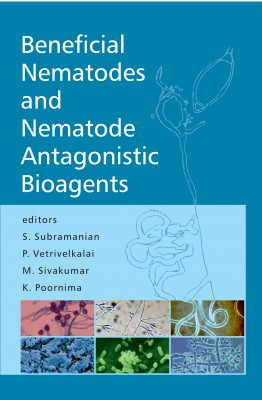
The book 'Beneficial Nematodes and Nematode Antagonistic Bioagents' is an essential resource for researchers, pest control professionals, and agricultural practitioners focusing on sustainable pest management. Authored by S. Subramanian, R. Vetrivelkalai, M. Sivakumar, and K. Poornima, this hardback volume is divided into two comprehensive sections. Section one delves into the isolation, identification, and mass production of antagonistic bioagents, including bacteria, fungi, and actinomycetes, providing valuable methodologies for pest management. The second section focuses on entomopathogenic nematodes, detailing their isolation, mass culturing techniques, and their application against economically significant insect pests. By integrating biological control strategies, this book advocates for the effective use of nematodes and other bioagents in integrated pest management (IPM) systems, offering practical insights on formulations, shelf life, and field application. Perfect for professionals aiming to develop sustainable agricultural practices, this publication not only highlights the benefits of these organisms but also addresses future prospects in pest control, making it a vital addition to any agricultural library.
Key Features
| Features | Description |
|---|---|
| Comprehensive Coverage | Detailed insights into beneficial nematodes and antagonistic bioagents |
| Practical Methodologies | Step-by-step protocols for isolation and mass multiplication of bioagents |
| Expert Contributions | Authored by leading researchers in the field of pest management |
| Focus on Sustainability | Promotes environmentally friendly pest control strategies |
| Field Application Insights | Practical guidelines for the use of nematodes in agricultural settings |
| Attributes | Description |
|---|---|
| Authors | S. Subramanian, R. Vetrivelkalai, M. Sivakumar, K. Poornima |
| Format | Hardback |
| Publisher | Not specified |
| Total Chapters | 24 chapters |
| Key Topics | Isolation, identification, mass multiplication of entomopathogenic nematodes and bioagents |
| Intended Audience | Researchers, pest control professionals, agricultural practitioners |
*Disclaimer: The above description has been AI-generated and has not been audited or verified for accuracy. It is recommended to verify product details independently before making any purchasing decisions.
The book extensively covers the isolation, identification, mass multiplication, formulations, and field potential of entomopathogenic nematodes, focusing on their application against economically important insect pests.
The authors, S. Subramanian, R. Vetrivelkalai, M. Sivakumar, and K. Poornima, are leading experts in pest management and biological control, contributing significant knowledge and methodologies in this field.
By integrating biological control approaches using beneficial nematodes and antagonistic bioagents, the book promotes environmentally friendly pest management strategies, essential for modern agricultural practices.
The book includes step-by-step protocols for the isolation and mass production of both bioagents and entomopathogenic nematodes, equipping practitioners with the tools necessary for effective pest control.
Understanding the shelf life of different bioformulations is crucial for their effective application in the field, ensuring that farmers and pest control professionals utilize viable products for optimal results.
Brand: nipa
Country Of Origin: India
"The use of entomopathogenic nematodes in pest control strategies, along with bacteria, fungi, and actinomycetes, is a promising approach to combating plant parasitic nematodes. The book Beneficial Nematodes and Nematode Antagonistic Bioagents is divided into two sections. The first section (chapters 1 to 16) covers the isolation, identification, molecular characterization, mass multiplication, formulations, and shelf life of bacteria, fungi, and actinomycetes. The second section (chapters 17 to 24) focuses on the isolation, identification, mass culturing of insect hosts, and mass multiplication, formulations, and field potential of entomopathogenic nematodes against economically important insect pests.
"
"The use of entomopathogenic nematodes in pest control strategies, along with bacteria, fungi, and actinomycetes, is a promising approach to combating plant parasitic nematodes. The book Beneficial Nematodes and Nematode Antagonistic Bioagents is divided into two sections. The first section (chapters 1 to 16) covers the isolation, identification, molecular characterization, mass multiplication, formulations, and shelf life of bacteria, fungi, and actinomycetes. The second section (chapters 17 to 24) focuses on the isolation, identification, mass culturing of insect hosts, and mass multiplication, formulations, and field potential of entomopathogenic nematodes against economically important insect pests.
"
Content
"PART-I (Bioagents for Plant Parasitic Nematodes) 1. Biological Control Revisiting the Basic Principles - R.K. Walia 2. Bacterial Antagonists Against Phytonematodes S. Nakkeeran and C. Dheepa 3. Fungal Antagonists Against Phytonematodes A.S. Krishnamoorthy and R. Priyanka 4. Mass Production of Fungal and Bacterial Antagonists S. Nakkeeran, G. Karthikeyan and S. Vinod Kumar 5. Formulation and Registration Protocols for Bioagents S. Nakkeeran, K. Eraivan Arutkani Aiyanathan and M. Muthamilan 6. Bioagents As A Component of IPM S. Harish and S. Rajamanicam 7. Notes for Practical Sessions Preparation of Media for Isolation of Bioagents S. Nakkeeran and C. Dheepa 8. Isolation of Antagonistic Trichoderma, Rhizobacteria and Actinomycetes A.S. Krishnamoorthy and R. Priyanka 9. Mass Multiplication of Trichoderma viride S. Nakkeeran, S. Vasumadhi and S. Vinod Kumar 10. Mass Multiplication of Pseudomonas fluorescens S. Nakkeeran, R. Dheepa and A. Ramanathan 11. Mass Multiplication of Bacillus subtilis S. Harish, S. Rajamanicam and S. Rageshwari 12. Assessing the Shelf life of Bioformulations S. Harish, S. Rajamanicam and S. Rageshwari 13. Extraction of DNA from the Biocontrol Agents L. Rajendran and S. Rageshwari 14. PCR Detection of Antibiotics Producing Genes from Antagonistic Bacillus S. Harish, S. Rajamanicam and S. Rageshwari 15. Agarose Gel Electrophoresis for Detection of Biocontrol Agents S. Nakkeran and S. Rageshwari 16. Isolation of Secondary Metabolites from Culture Filtrate of Trichoderma viride and Chaetomium globosum S. Nakkeran and S. Vinodkumar PART-II (Entomopathogenic Nematodes) 17. Introductory Lecture on Entomopathogenic Nematodes S. Subramanian 18. Mass Production of Corcyra cephalonia Stainton and Greater wax moth, Galleria mellonella S. Sridharan, P.A. Saravanan and T. Manoharan 19. Taxonomy and Identification of Steinernema and Heterorhabditis M. Sivakumar and S. Subramanian 20. Microscopic Examination and Identification of Steinernema and Heterorhabditis K. Poornima 21. Mass Multiplication of Entomopathogenic Nematodes by in vivo and in vitro Methods N. Swarnakumari 22. Basic Laboratory Methods Associated with Entomopathogenic Nematodes P. Vetrivelkalai 23. Field Potential of Entomopathogenic Nematodes Against Different Economically Important Insects C. Sankaranarayanan 24. Field Application of Entomopathogenic Nematodes Formulations and Future Prospects J. Gulsar Banu
"
Inclusive of all taxes
You Save: 0
North Delhi , India
Service Provider , Manufacturer, Professional Services, Brand Owner, Distributor, Exporter, Importer, Wholesaler, Startup