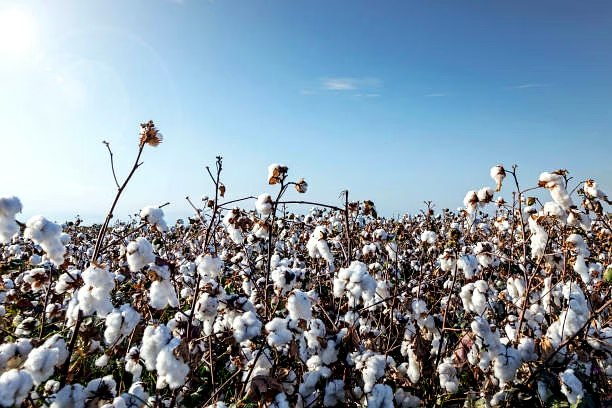
Indian Raw Cotton is a premium agricultural commodity representing India's vast cotton production landscape. Known for its varying staple lengths, Indian raw cotton is prized for qualities such as fiber strength, uniformity, colour, brightness, and purity, all essential for manufacturing high-quality textiles. Its micronaire values typically range between 3.5 and 4.5, indicating fine fiber fineness suitable for diverse yarn production. The cotton variety spans three major cultivation zones across Northern, Central, and Southern India, enabling a broad supply chain catering to domestic textile mills and international markets. The advent of Bt cotton has bolstered yield efficiencies and reduced pesticide dependencies, supporting sustainable and profitable farming practices. The cotton is graded based on fiber strength, absence of foreign matter, and brightness, with premium grades receiving higher market prices. With India being one of the top global raw cotton exporters, this product serves as a vital input for industries focused on quality fabric production, ensuring durability, consistency, and superior textile performance.
Key Features
| Features | Description |
|---|---|
| Origin | India's Northern, Central, and Southern cotton growing regions |
| Staple Length | Varies, typically includes longer staple lengths for finer yarns |
| Micronaire Value | Ranges from 3.5 to 4.5 indicating fiber fineness |
| Fiber Strength | High fiber strength ensuring durability of fabrics |
| Purity | High purity with minimal foreign matter |
| Brightness | Superior brightness contributing to fabric aesthetics |
| Cotton Variety | Includes Bt cotton varieties for improved yield and quality |
| Export Standing | India ranks as third largest global exporter of raw cotton |
| Suitability | Ideal for high-quality textiles and finer yarn spinning mills |
| Government Support | Policies and incentives supporting production and export |
| Attributes | Description |
|---|---|
| Staple Length Range | Typically variable; longer staple lengths preferred for premium textiles |
| Micronaire Value | 3.5 - 4.5 |
| Fiber Strength | Uniform and strong fibers ensuring consistent fabric quality |
| Purity Grade | High grade with minimal foreign matter |
| Color and Brightness | Bright and consistent, suited for quality fabric manufacturing |
| Cultivation Zones | Northern (Punjab, Haryana, Rajasthan), Central (Madhya Pradesh, Maharashtra, Gujarat, Orissa), Southern (Andhra Pradesh, Telangana, Karnataka, Tamil Nadu) |
| Bt Cotton Area Coverage | Significantly increased, enhancing yield and reducing pesticide usage |
| Export Share | Approximately 10.2% of global raw cotton exports |
| Use Cases | Raw material for spinning mills, textile manufacturers and exporters |
*Disclaimer: The above description has been AI-generated and has not been audited or verified for accuracy. It is recommended to verify product details independently before making any purchasing decisions.
Indian raw cotton includes various staple lengths, with longer staples commanding premium prices. Longer staples are preferred because they enable spinning of finer yarns that result in higher quality, softer, and more durable textiles.
The micronaire value, typically ranging from 3.5 to 4.5 in Indian cotton, indicates fiber fineness. Values within this range make the cotton ideal for producing fine yarns and smooth fabrics, ensuring uniformity and enhanced fabric aesthetics.
The adoption of Bt cotton varieties has significantly increased yields and reduced pesticide costs for farmers in India, leading to higher quality raw cotton supply and better competitive positioning in domestic and global markets.
Indian raw cotton is grown mainly in Northern (Punjab, Haryana, Rajasthan), Central (Madhya Pradesh, Maharashtra, Gujarat, Orissa), and Southern (Andhra Pradesh, Telangana, Karnataka, Tamil Nadu) zones. Each region contributes distinct quality attributes based on climate and soil, affecting fiber strength, staple length, and purity.
Grading is determined by factors such as fiber strength, absence of foreign matter, brightness, and purity. Premium grades exhibiting higher fiber strength and superior purity command better prices in both domestic and international markets.
Brand: mcu-5, organic cotton & other variety
Country Of Origin: India
The Indian raw cotton market is influenced by a combination of domestic and global factors, leading to fluctuating prices. Longer staple lengths generally command higher prices due to their suitability for finer yarns and higher-quality textiles.Factors like colour, brightness, and purity which are crucial for fabric durability and consistency. Cotton with superior strength and uniformity is preferred and priced accordingly. Micronnaire values, which indicate fiber fineness, typically range from 3.5 to 4.5 for various Indian cotton varieties. (absence of foreign matter) determine the grade, with premium grades fetching higher prices.This refers to the fiber's strength and uniformity
Indian Raw cotton variety
1) MCU-5,
2) SANKAR-6
3) BCI COTTON
4) ORGANIC COTTON
5) J-34
India is the world's largest producer of cotton. In 2020, India was the third-largest exporter of raw cotton globally, accounting for about 10.2% of total exports. Cotton is a major cash crop, vital to the Indian economy and the livelihoods of millions of farmers and those involved in the cotton trade and processing.The area under Bt cotton has significantly increased, contributing to higher yields and reduced pesticide costs for farmers. The government implements various policies and schemes to support the cotton industry, including incentives for spinning mills and support for exporters. Cotton is grown in three main zones: Northern (Punjab, Haryana, Rajasthan), Central (Madhya Pradesh, Maharashtra, Gujarat,Orissa), and Southern (Andhra Pradesh, Telangana, Karnataka, Tamil Nadu).