• Key Features & Attributes
  • Ratings & Reviews
  • Know your Supplier
  • Product description from supplier

Fiber Reinforced plastics

Inclusive of all taxes

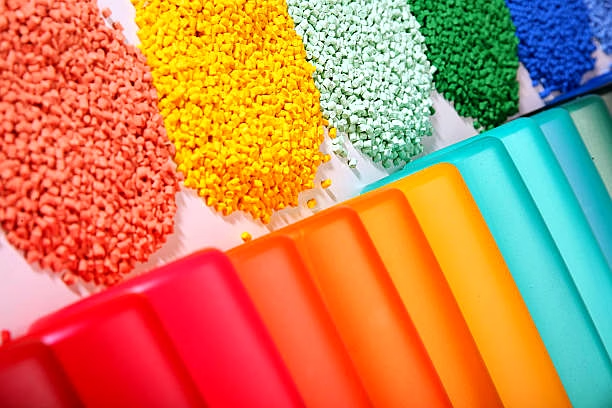
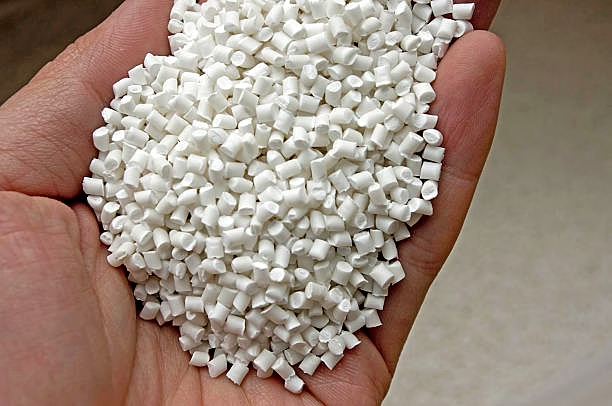
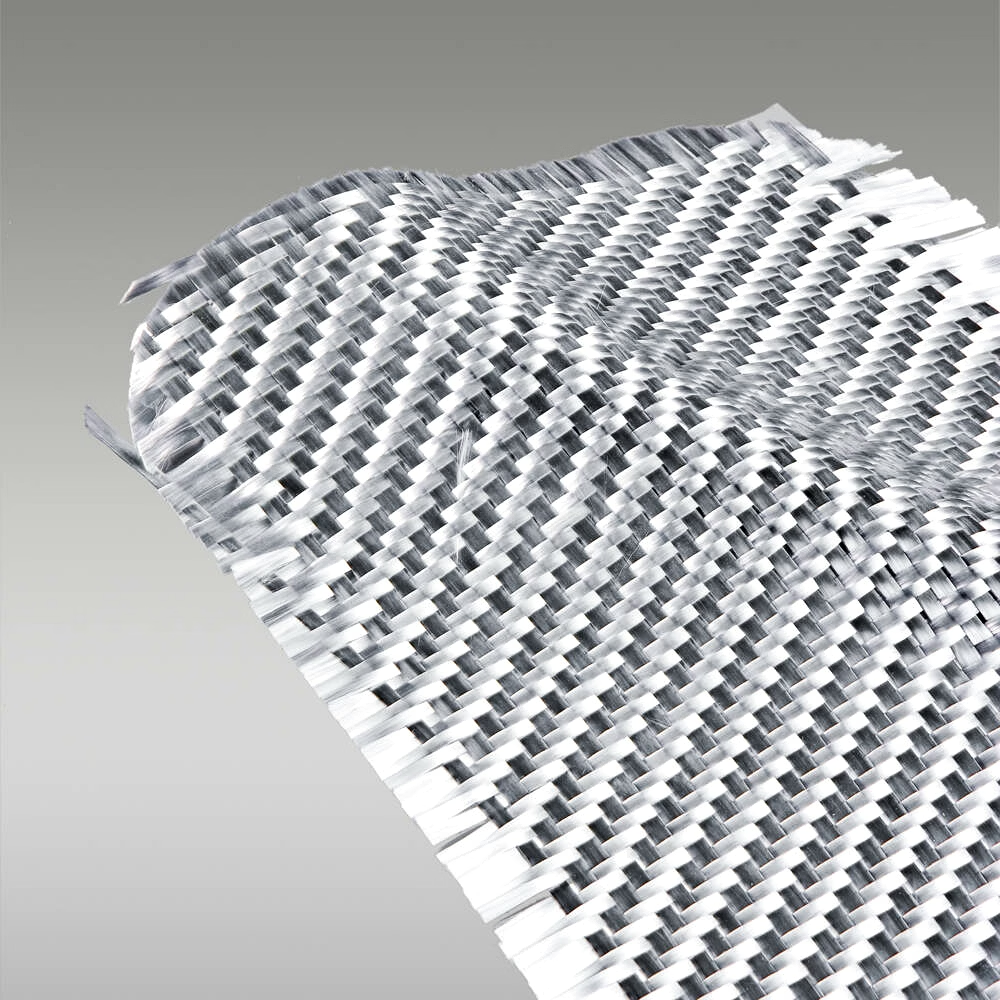
Fiber Reinforced Plastics (FRP) are high-performance composite materials designed for demanding industrial applications that require a combination of lightweight construction, mechanical strength, corrosion resistance, and long service life. Manufactured by reinforcing a polymer matrix with fibers such as glass, carbon, aramid, or basalt, FRP delivers a superior strength-to-weight ratio compared with many conventional metals and engineering plastics. This product is especially relevant for buyers seeking reliable composite material supply for fabrication, molding, structural components, chemical exposure environments, and lightweight part production. The polymer matrix—commonly epoxy, polyester, or vinyl ester—binds the fibers together while protecting them from moisture, chemicals, and environmental degradation. The reinforcing fibers carry the load and improve stiffness, tensile strength, fatigue resistance, and dimensional stability. FRP is widely valued across industrial procurement because it combines performance and versatility. Glass fiber reinforced plastics are the most common form due to their cost efficiency and balanced mechanical properties, while carbon fiber reinforced variants are selected for higher stiffness and strength. Aramid fibers improve impact and heat resistance, and basalt fibers offer additional durability in harsh operating conditions. From a production standpoint, FRP can be processed using multiple manufacturing methods depending on the end-use requirement. Hand lay-up is suitable for custom and low-volume parts, pultrusion is ideal for continuous profiles such as rods, beams, and channels, and filament winding is used for reinforced cylindrical products like pipes and tanks. Closed molding techniques such as resin transfer molding (RTM) provide improved precision and repeatability for industrial components. Because of its non-magnetic, non-sparking, corrosion-resistant, and low thermal expansion characteristics, FRP is commonly sourced for chemical plants, marine equipment, infrastructure, electrical applications, transport components, and industrial fabrication. For B2B buyers, it is a dependable raw material and engineering composite for manufacturing durable, lightweight, and corrosion-proof parts. Indian Stalwart Global Sourcing Company offers FRP sourcing support for bulk procurement and export-oriented supply requirements.

Key Features

Features Description
Material Type Fiber-reinforced polymer composite
Reinforcement Fibers Glass, carbon, aramid, or basalt fibers
Matrix Material Epoxy, polyester, or vinyl ester resin
Strength-to-Weight Ratio High
Corrosion Resistance Excellent
Electrical/Static Properties Non-magnetic and non-sparking
Fatigue Performance Good fatigue tolerance
Processing Methods Hand lay-up, pultrusion, filament winding, RTM
Attributes Description
Product Name Fiber Reinforced Plastics (FRP)
Store Name Indian Stalwart Global Sourcing Company
MOQ 1
DOM Unit KG
Product Type Composite material
Base Matrix Polymer resin
Common Resin Systems Epoxy, polyester, vinyl ester
Common Reinforcements Glass fiber, carbon fiber, aramid fiber, basalt fiber
Primary Advantages High strength, lightweight, corrosion resistance, durability
Typical Manufacturing Processes Hand lay-up, pultrusion, filament winding, resin transfer molding
Key Performance Characteristics Low thermal expansion, impact resistance, chemical resistance
Industrial Suitability Suitable for structural, chemical, marine, and fabrication applications

*Disclaimer: The above description has been AI-generated and has not been audited or verified for accuracy. It is recommended to verify product details independently before making any purchasing decisions.

Be the first to write a review

Glass fiber is the most common reinforcement because it offers a strong balance of cost, strength, and lightweight performance.

Epoxy, polyester, and vinyl ester resins are commonly used, with vinyl ester often selected for enhanced chemical resistance.

Pultrusion is the most suitable method for continuous profiles such as beams, channels, rods, and tubes.

FRP resists corrosion and chemical attack, making it suitable where metals may degrade quickly in harsh environments.

Yes, filament winding is commonly used to manufacture hollow cylindrical parts such as pipes, tanks, and pressure-related components.

  • Incorporation Type

  • GST

  • GST Registration Date

  • Number of Employees

  • Import Export Code (IEC)

  • Year of Establishment

  • Nature of Business

  • GlobalLinker Member Since

Looking for Fiber Reinforced Plastics(FRP)? Indian Stalwart Global Sourcing Company is the ideal sourcing partner for your procurement needs.


Fiber-reinforced plastics (FRP), also known as fiber-reinforced polymers, are composite materials combining a polymer matrix with reinforcing fibers for enhanced strength and durability.


Composition:

FRP consists of a plastic matrix, typically thermosetting resins like epoxy, polyester, or vinyl ester, reinforced by fibers such as glass, carbon, aramid, or basalt.

The fibers provide mechanical strength, stiffness, and elasticity, while the matrix binds them together and protects against environmental damage.

Glass fibers are the most common due to their cost-effectiveness and balance of strength and weight.


FRP offers a high strength-to-weight ratio, corrosion resistance, low thermal expansion, and good fatigue tolerance compared to metals.

It resists chemicals, impact, and extreme temperatures, with non-magnetic and non-sparking qualities. Properties vary by fiber type: carbon boosts stiffness, aramid adds heat resistance.

Fiber-reinforced plastics (FRP) are manufactured through various processes that combine reinforcing fibers with a polymer matrix resin, followed by curing to form strong composites.

Main Manufacturing Methods

Common techniques include hand lay-up, where dry fibers are placed in a mold and manually saturated with wet resin, then cured at room temperature or with heat.

Pultrusion pulls continuous fiber rovings through a resin bath, shapes them in a die, and cures them under heat for profiles like beams or tubes.

Filament winding wraps fibers around a rotating mandrel, applies resin, and cures to create hollow cylindrical parts like pipes.

Key Process Steps

Most methods start with fiber preforms (dry or pre-impregnated with resin), wet them via resin infusion or spraying, and compact under vacuum or pressure to remove air voids.

Curing uses heat, pressure, or autoclaves to harden the resin, bonding fibers into the final shape; post-processing may include trimming.

Glass fibers, the most used, are extruded from molten glass into filaments before weaving or roving preparation.

Open vs. Closed Molding

Open molding, like spray-up, uses a chopper gun to deposit chopped fibers and resin into an open mold for large, low-volume parts.

Closed molding, such as resin transfer molding (RTM), injects resin into a sealed mold with pre-placed fibers for higher precision and volume.


Machinery And Tools

Fabrication Services

Composite Fabrication

Fiber Reinforced Composites

Fiber Reinforced Plastics

FRP Composite

Glass Fiber Reinforced Plastic

Polymer Composite Material

Corrosion Resistant Composite

Lightweight Industrial Composite

Pultruded FRP

Filament Wound FRP

Fiber Reinforced plastics

Inclusive of all taxes

You Save: 0

Send Inquiry
Indian Stalwart Global Sourcing Company

Chennai , India

Service Provider , Service Center, Manufacturer, Professional Services, Contractor, Retailer, Brand Owner, Distributor, Exporter, Importer, Wholesaler, Startup

GST- 33BBJPT6176P1ZR

  • Days
    Returnable

  • Secure
    Transaction

  • Free
    Delivery

  • Cancellations
    Refund &

  • Day
    Dispatch

Report a problem with this product