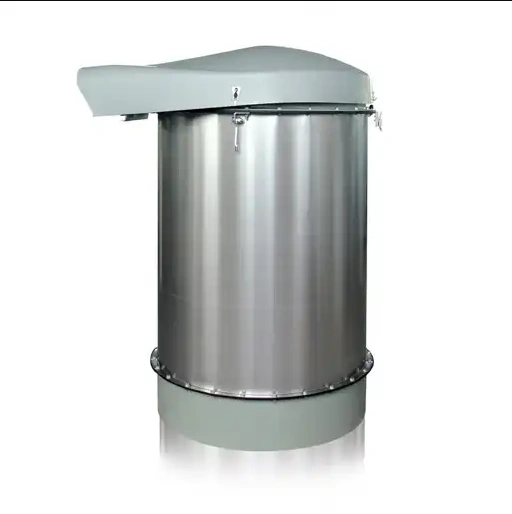
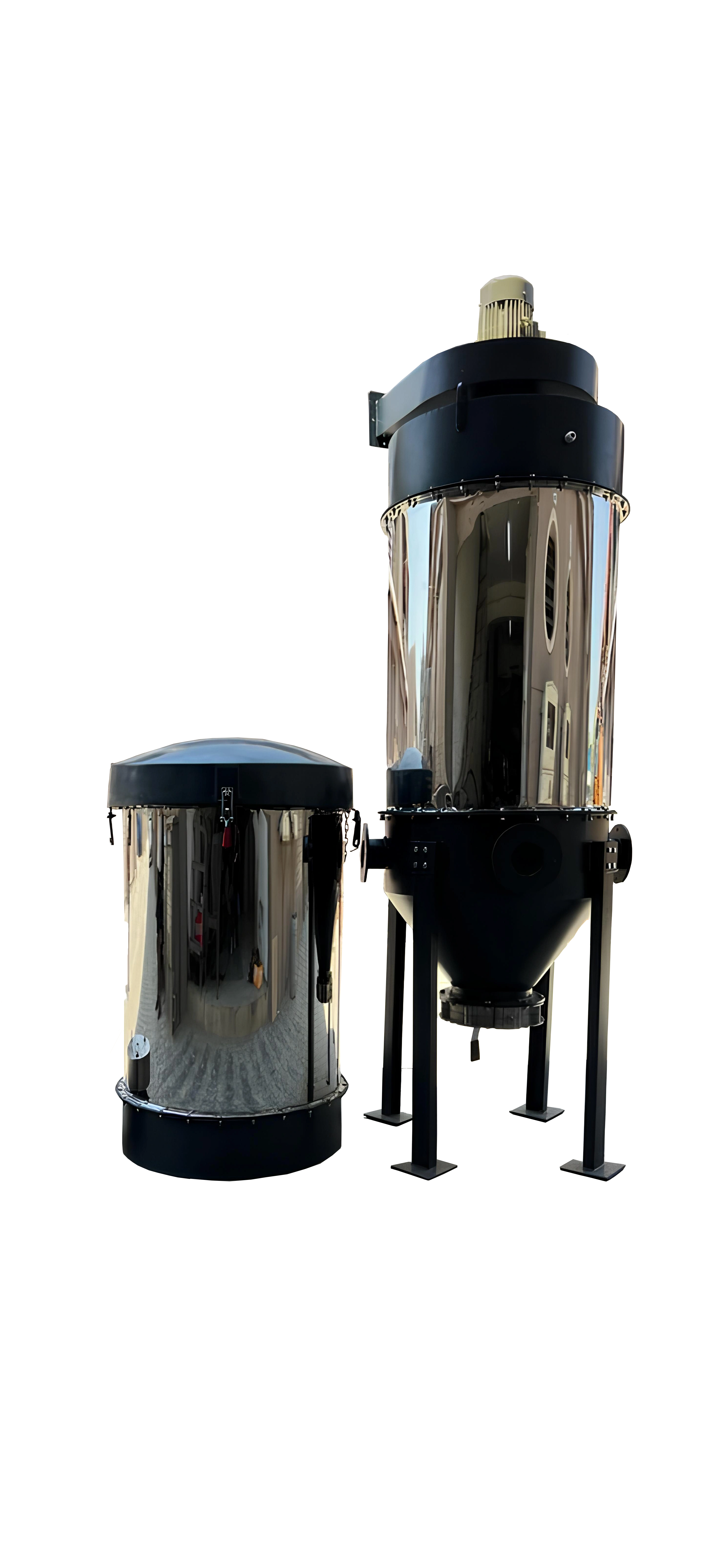
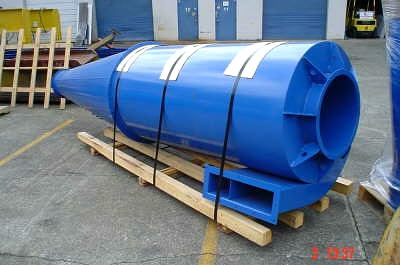
The Cyclone Dust Collector is an industrial-grade particulate removal system designed to extract dust particles from air or gas streams by leveraging centrifugal force. It operates without filters, using a vortex spiral to separate larger dust and particulate matter efficiently. The collector's robust construction accommodates harsh operational environments such as woodworking, metalworking, grain processing, and combustion systems. Its no-moving-parts design ensures minimal maintenance and reduces operational costs significantly. Available in conventional and high-efficiency models, these cyclones offer versatile configurations tailored to specific applications and dust load requirements. The conventional cyclone is optimized for medium efficiency with high throughput, suitable for coarse particle collection, achieving 50-80% efficiency for 10-micron particles. For superior performance, the high-efficiency cyclone achieves 80-95% collection efficiency on fine particles and can be configured in parallel or series to handle increased gas volumes without added power costs or increased floor space. This adaptability makes the Cyclone Dust Collector a cost-effective, low-maintenance, and powerful solution for industrial dust collection systems, extending filter lifespan downstream and ensuring cleaner air exhausts.
Key Features
| Features | Description |
|---|---|
| Dust Separation Method | Centrifugal force-driven vortex spiral flow |
| Maintenance | No moving parts, minimal maintenance required |
| Collection Efficiency | 50-80% for conventional cyclone; 80-95% for high-efficiency cyclone |
| Design Types | Conventional cyclone and high-efficiency cyclone models available |
| Application Areas | Woodworking, metalworking, grain processing, combustion systems |
| Robustness | Operates reliably in harsh industrial environments |
| Cost-Effectiveness | No consumable filters needed; reduces downstream filter replacement frequency |
| Capacity Handling | High gas throughput with scalable configurations (parallel or series) |
| Dust Discharge | Dust collected in dedicated storage receiver |
| Attributes | Description |
|---|---|
| Inlet Design | Tangential entry for creating vortex flow |
| Particle Size Efficiency | Designed for coarse and fine particulates, down to 10 microns |
| Material Handling Capability | Handles fly-ash, wood char, abrasive dust, and combustibles |
| Gas Flow Patterns | Cylindrical or conical chamber with spiraling gas flow |
| Dimensional Options | Various sizes available depending on efficiency and capacity requirements |
| Installation Options | Single units or multiple units in parallel/series configurations |
| Operational Environment | Suitable for industrial facilities with heavy dust generation |
| Dust Collection Efficiency (10 µm particles) | Conventional: 50-80%, High Efficiency: 80-95% |
| Power Consumption | Comparable or lower than filter-based systems due to no filter resistance |
| Maintenance Frequency | Reduced due to absence of filters or moving components |
*Disclaimer: The above description has been AI-generated and has not been audited or verified for accuracy. It is recommended to verify product details independently before making any purchasing decisions.
By removing larger dust particles before they reach downstream filters, the cyclone decreases filter loading, which extends filter life and reduces replacement frequency.
The required particle collection efficiency and space constraints dictate model choice; conventional cyclones suit coarse dust with moderate efficiency, while high-efficiency models are preferred for finer dust and higher separation rates.
Yes, cyclones can be arranged in parallel or series configurations to handle larger gas volumes and optimize collection efficiency without significant increases in power usage.
Yes, its robust construction and absence of moving parts make it ideal for handling abrasive dust such as wood char and fly-ash in industrial settings.
Cyclone dust collectors require less maintenance due to no moving parts or filter media, have lower operational costs, handle higher dust loads, and operate effectively in harsh conditions without clogging.
Country Of Origin: India
A cyclone dust collector is a device that uses centrifugal force to remove particulate matter from air or gas streams, effectively separating larger dust particles from the airflow without the need for filters.
No Moving Parts: Cyclone dust collectors are simple in design and do not have moving parts, which reduces maintenance needs and operational costs.
1
High Efficiency: They can remove a significant percentage of dust particles, particularly larger and heavier ones, making them suitable for environments with high dust production.
2
Versatile Applications: Commonly used in industries such as woodworking, metalworking, and grain processing, cyclone dust collectors are effective for managing coarse and abrasive dust.
2
3 Sources
Advantages
Reduced Filter Maintenance: By capturing larger particles before they reach filters, cyclone dust collectors extend the life of downstream filtration systems and reduce the frequency of filter replacements.
2
Cost-Effective: They are often less expensive to operate than traditional dust collection systems that rely on filters, as they do not require consumable filter media.
1
Robust Design: Cyclones are built to handle heavy dust loads and can operate in harsh conditions, making them ideal for industrial applications.
1
In summary, cyclone dust collectors are efficient, low-maintenance solutions for controlling dust in various industrial settings, leveraging the principles of centrifugal force to separate and collect particulate matter from air streams.
The cyclone is a widely used type of particulate collection device in which
dust-laden gas enters tangentially into a cylindrical or conical chamber and leaves
through a central opening. The resulting vortex motion or spiraling gas flow pattern
creates a strong centrifugal force field in which dust particles, by virtue of their inertia,
separate from the carrier gas stream. They then migrate along the cyclone walls by gas
flow and gravity and fall into a storage receiver. In a boiler or incinerator installation this
particulate is composed of fly-ash and unburned combustibles such as wood char.
CYCLONES ARE GENERALLY classified according to their gas inlet design and dust
discharge design, their gas handling capacity and collection efficiency, and their
arrangement. Figure 6-2 illustrates the various types of gas flow and dust discharge
configurations employed in cyclone units.
CONVENTIONAL CYCLONE. The most commonly used cyclone is the medium
efficiency, high gas throughput (conventional) cyclone. Typical dimensions are illustrated
in figure 6-3. Cyclones of this type are used primarily to collect coarse particles when
collection efficiency and space requirements are not a major consideration. Collection
efficiency for conventional cyclones on 10 micron particles is generally 50 to 80 percent.
HIGH EFFICIENCY CYCLONE. When high collection efficiency (80-95 percent) is a
primary consideration in cyclone selection, the high efficiency single cyclone is commonly
used A unit of this type is usually smaller in diameter than the
conventional cyclone, providing a greater separating force for the same inlet velocity and
a shorter distance for the particle to migrate before reaching the cyclone walls. These
units may be used singly or arranged in parallel or series as shown in figure 6-5. When
arranged in parallel they have the advantage of handling larger gas volumes at increased
efficiency for the same power consumption of a conventional unit. In parallel they also
have the ability to reduce headroom space requirements below that of a single cyclone
handling the same gas volumes by varying the number of units in operation.