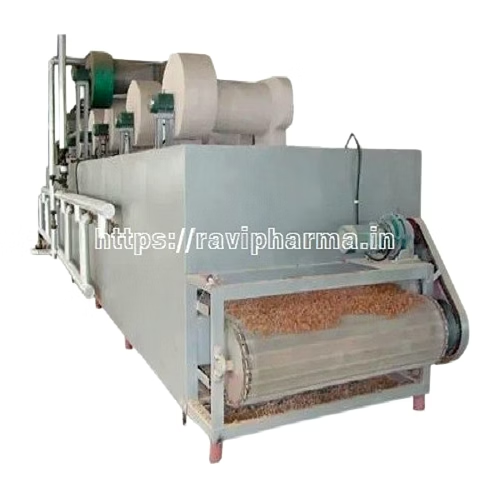
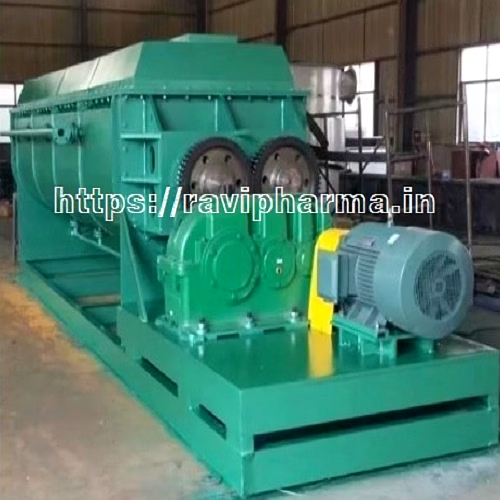
The RAVI Continuous Rotary Paddle Dryer is an advanced industrial drying solution designed specifically for the continuous drying, cooling, heating, sterilizing, reacting, and combustion of paste, particles, powdery materials, slurry, and high viscosity substances. Engineered with hollow chock-shaped or wedge-shaped blades mounted on a hollow shaft, this equipment optimizes heat transfer by circulating heating media such as steam or thermal oil through the blades at temperatures ranging from -40°C up to 300°C. The innovative design ensures maximum heat transfer efficiency within the effective volume, allowing for indirect heating without the involvement of air, thus reducing heat loss and enabling energy-efficient operation. The product features a self-cleaning blade surface to prevent material buildup, adjustable overflow weir to control material residence time, and a sealed design to prevent contamination or leakage. It supports treatment under vacuum conditions for heat-sensitive materials and accommodates high-moisture or viscous slurry. This highly customizable rotary paddle dryer is ideal for industries that require precise and continuous drying processes while maintaining product integrity and energy efficiency.
Key Features
| Features | Description |
|---|---|
| Continuous Operation | Enables continuous feed, drying, and discharge of materials for uninterrupted processing |
| Heat Transfer Mechanism | Hollow chock-shaped or wedge-shaped blades with heating media flow inside blades and hollow shaft |
| Temperature Range | Operating temperature range from -40ºC to 300ºC, suitable for a variety of heating media |
| Material Types | Capable of drying paste, particles, powdery materials, slurry, and high viscosity substances |
| Indirect Heating | No heat carried out by air ensuring efficient heat utilization and reducing heat loss |
| Self-Cleaning Blades | Blade surface designed to prevent material buildup during operation maintaining high heat transfer efficiency |
| Vacuum Operation | Optional vacuum condition support for heat-sensitive materials to prevent thermal damage |
| Adjustable Residence Time | Overflow weir height can be adjusted to control material residence time within the dryer |
| Sealed Construction | Equipped with sealed terminal and top covers to prevent leakage and dust contamination |
| Thermal Media Compatibility | Compatible with various heating media including steam and thermal oil |
| Attributes | Description |
|---|---|
| Blade Type | Hollow chock-shaped or wedge-shaped blades |
| Heating Media | Steam, thermal oil, or other liquid-state heating media |
| Operating Temperature | -40ºC to 300ºC |
| Material Handling | Paste, particles, powdery materials, slurry, and highly viscous materials |
| Heating Mode | Indirect heating through hollow blades and jacket |
| Construction Material | Ω-shaped shell with sealed terminal and top covers |
| Number of Hollow Stirring Shafts | Typically 2 or 4 shafts depending on model |
| Vacuum Option | Available for temperature-sensitive material processing |
| Discharge Method | Rotary discharger for continuous material output |
| Self-Cleaning Feature | Relative movement between particles and blade surface prevents buildup |
*Disclaimer: The above description has been AI-generated and has not been audited or verified for accuracy. It is recommended to verify product details independently before making any purchasing decisions.
Yes, the rotary paddle dryer is specifically designed to handle slurry and highly viscous materials efficiently due to its hollow paddle design and adjustable residence time.
The dryer supports various heating media including steam and thermal oil, allowing operation in the temperature range of -40ºC to 300ºC.
Yes, the paddle dryer can operate under vacuum conditions to safely dry heat-sensitive materials without thermal degradation.
The chock-shaped blades feature a self-cleaning surface that prevents material buildup and maintains optimal heat transfer efficiency during continuous operation.
The residence time is adjustable by changing the height of the overflow weir, allowing customization based on processing requirements.
No, the equipment is designed with sealed terminal and top covers on the shell, preventing any leakage of materials or dust contamination.
Country Of Origin: India
Working Principle :-
The Hollow chock shaped blades or wedge-shaped blades are concentrated on the hollow shaft. Heating media flows through the blades from the hollow shaft. The heat transfer area in the effective volume is very high. The temperature range of heating media is – 40 ºC to 300 ºC. Heating source could be steam, liquid state, such as steam, thermal oil etc.
A heating medium enters the hollow rotary shafts and paddles through a rotary feeder. After heat transfer and drying, it is discharge through the rotary discharger. The materials is continuously fed into the equipment. Next it is agitated and mixed near the paddles. At the same time, the material is gradually dried by the heat conduction of paddle and jacket. The height of overflow weir can be change to adjust residence time. In addition, steam produced in the drying process discharges through the escape hole with trace amount of air. By using oil for the heat medium, it is possible to use high temperature up to 300 Deg. C.
Slurry with high moisture content or material with high viscosity can be treated. Available under vacuumed condition as well, for materials which are sensitive to high temperature.
Indirect heating, there’s no heat carried out by air. All heat is utilized to dry the materials except the lost of heat insulation layers. The surface of chock shaped blade has self-cleaning function. The relative movements of the product particles and the chocked shaped blades surface might clean the materials attached to the blades surface, so the heat transferring surface is clean during working.
The shell of hollow blade paddle dryer is Ω shape. 2 or 4 pieces of hollow stirring shaft are usually equipped in the shell. To avoid any leakage of materials and dust, there’re sealed terminal cover and top cover with the shell. The heat transferring media flow through the rotation connector, jacket’s shell and hollow stirring shaft.
The heat transfer medium passes through the rotary joint, through the housing jacket and hollow shaft, the hollow mixing shaft in accordance with the type of the heat media has a different internal structure, to ensure optimum heat transfer effect.
Inclusive of all taxes
You Save: 0