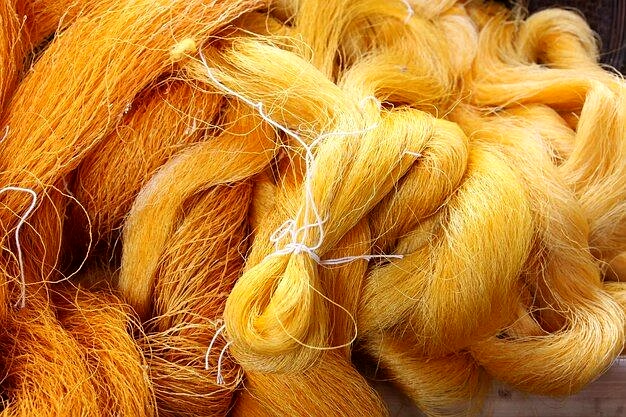
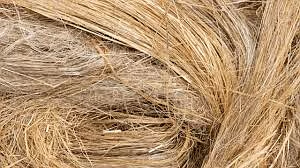
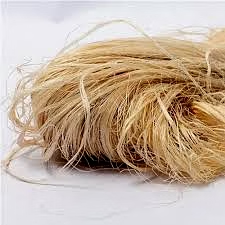
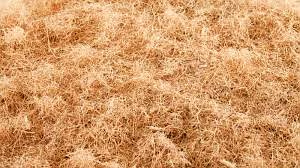
Banana Short Fiber is a sustainable and eco-friendly material derived from the short-length fibers of the banana pseudostem. These fibers consist mainly of lignocellulosic materials such as cellulose, hemicellulose, and lignin, making them naturally biodegradable and renewable. Unlike the long banana fibers traditionally used in textiles, banana short fibers offer unique mechanical reinforcement properties when integrated into composite materials. Their compatibility with plastics and polymers makes them an ideal choice for enhancing structural strength, durability, and flexibility in various industrial applications. These fibers are increasingly utilized as a greener alternative in automotive interiors, construction panels, packaging materials, and other composite products, contributing to reduced dependency on synthetic fibers and promoting sustainability in manufacturing processes. With high renewability and effective reinforcing characteristics, banana short fibers present a valuable resource for companies seeking environmentally responsible material solutions.
Key Features
| Features | Description |
|---|---|
| Fiber Type | Short-length banana pseudostem fibers |
| Composition | Cellulose, Hemicellulose, Lignin |
| Source | Banana plant pseudostem waste |
| Sustainability | Renewable and biodegradable |
| Application Use | Reinforcement in composites (plastics, polymers) |
| Industrial Applications | Automotive interiors, construction materials, packaging |
| Mechanical Benefits | Improves strength, flexibility, and durability |
| Eco-friendly Alternative | Replaces synthetic fibers in composites |
| Processing Compatibility | Compatible with polymer matrices and plastic composites |
| Attributes | Description |
|---|---|
| Fiber Length | Short-length fibers typically less than 50 mm |
| Fiber Diameter | 20-100 microns (approximate average) |
| Moisture Content | 5-10% (varies with processing) |
| Tensile Strength | Moderate – suitable for reinforcement |
| Density | Approximately 1.3 g/cm³ |
| Extraction Method | Mechanical extraction from banana pseudostems |
| Fiber Treatment | Can be chemically or mechanically treated to improve compatibility |
| Biodegradability | Fully biodegradable under composting conditions |
*Disclaimer: The above description has been AI-generated and has not been audited or verified for accuracy. It is recommended to verify product details independently before making any purchasing decisions.
Banana short fiber contains high cellulose content along with lignin and hemicellulose, providing natural strength and adhesion properties that enhance the mechanical performance of composite materials.
Yes, due to their strength, durability, and natural texture, banana short fibers are ideal for reinforcing polymer composites used in automotive interiors, offering a sustainable alternative to synthetic fibers.
These fibers are derived from agricultural waste and are fully biodegradable and renewable, reducing reliance on petroleum-based synthetic fibers and lowering environmental impact.
While banana short fibers are compatible with many common thermoplastics and thermosets, their surface may require treatments for optimal bonding in certain polymer matrices.
Banana short fibers generally measure less than 50 mm in length with diameters ranging between 20 to 100 microns, ideal for composite reinforcement applications.
Brand: eco rudra
Country Of Origin: India
Banana short fiber refers to the short-length fibers extracted from the banana pseudostem, which are composed of lignocellulosic material like cellulose, hemicellulose, and lignin. Unlike the long fibers used for textiles, these short fibers are often used as a reinforcing material in composites for applications like plastics and polymers to improve strength and other properties while being a renewable resource. These fibers have potential for use in automotive interiors, construction, and packaging materials, serving as a sustainable alternative to synthetic fibers