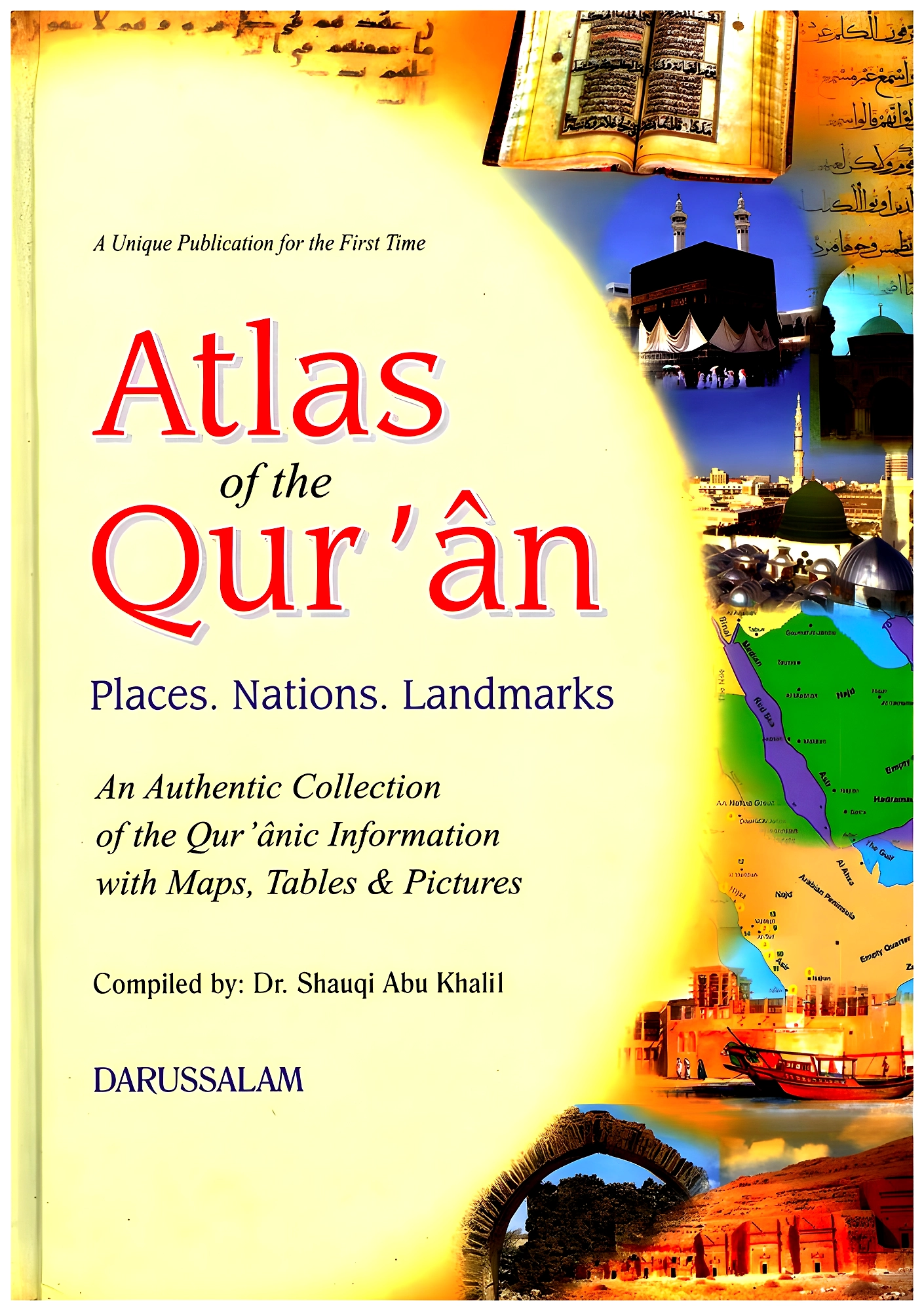
The Atlas of the Qur’an by Dr. Shawqi Abu Khalil is a pioneering reference book designed to enrich the understanding of the Qur’an by pinpointing the precise geographical locations mentioned within the Holy Text. This hardcover edition, published by DARUSSALAM, contains 392 pages of detailed maps and descriptions that help readers visually connect with the Qur’anic narratives, enhancing both study and recitation. Measuring 17 cm by 24 cm and weighing 1 kilogram, this English-language atlas brings to life locations of ancient peoples and significant events from the Prophetic Seerah. It reveals and clarifies obscure sites such as the resting place of Prophet Nuh’s Ark, the curved sand-hills known as Al Ahqah, the cave of the young faithful men, the houses of Madian, and the location of Sodom with accuracy based on authoritative sources. This scholarly yet accessible work serves as an indispensable tool for academics, educators, religious scholars, and institutions aiming to deepen their geographic and historic comprehension of the Qur’an.
Key Features
| Features | Description |
|---|---|
| Author | Dr. Shawqi Abu Khalil |
| Title | Atlas of the Qur’an |
| Language | English |
| Binding | Hardcover |
| Publisher | DARUSSALAM |
| Page Count | 392 pages |
| Dimensions | 17 cm x 24 cm |
| Weight | 1.000 KGS |
| Unique Content | First-ever Atlas specifically mapping locations mentioned in the Qur’an |
| Educational Use | Supports detailed Qur’anic studies and recitation by identifying historic locations |
| Coverage | Locations connected to prophetic incidents, ancient people, and obscure sites like Nuh’s Ark and Al Ahqah |
| Attributes | Description |
|---|---|
| Material | High-quality paper with durable hardcover binding |
| Country of Publication | Saudi Arabia |
| Subject Focus | Geographical locations and historical sites in the Qur’an |
| Target Audience | Researchers, educators, religious scholars, and students of Islamic studies |
| Reference Type | Geographical and historical reference |
| Edition Type | First edition |
| Illustrations | Detailed maps and descriptive annotations throughout the book |
*Disclaimer: The above description has been AI-generated and has not been audited or verified for accuracy. It is recommended to verify product details independently before making any purchasing decisions.
The Atlas provides visual geographical context by mapping the precise locations mentioned in the Qur’an and the Seerah, helping readers connect verses to real-world places, thus deepening comprehension of the narratives.
Yes, the Atlas bases its identifications of locations such as the site of Nuh’s Ark and Al Ahqah on authenticated historical and Islamic scholarly sources to ensure accuracy.
Absolutely. Its detailed maps and scholarly annotations make it an excellent resource for universities, Islamic seminaries, and study circles focusing on Qur’anic studies.
Yes, it specifically highlights obscure places that are often overlooked, enriching readers’ understanding of the Qur’anic text beyond common knowledge.
This edition is a hardcover book, measuring 17 x 24 cm, designed for durability and frequent academic use.
Country Of Origin: India
| Arabic Title |
اطلس القرآن |
| Title | Atlas of the Qur’an |
| Author | Dr. Shawqi Abu Khalil |
| Pages | 392 |
| Size | 17 cm x 24 cm |
| Language | ENGLISH |
| Binding | Hardcover |
| Publisher | DARUSSALAM |
| Weight | 1.000 KGS |
This Atlas is new in its subject, a subject that has not been touched before. It helps whoever recites the Qur’an or studies it to specify the locations mentioned by the Noble Verses, and to mark those places of ancient people mentioned in the Qur’an. This is besides locating areas where the incidents of the prophetic Seerah occurred. Eventually the diligent reader will easily recognize those places, learn about them, and take heed of them while reciting.
Eventually, the diligent reader will easily recognize those places, learn about them, and take heed of them while reciting. The Atlas has also revealed obscure places we used to pass through inattentively, like the site where Nuh’s Ark settled, the site of the curved Sand-hills {Al Ahqah}, the cave of the young faithful men, the houses of median, the site of Sodom and other places determined by the Atlas depending on reliable sources.