
 FIEO Registered
Our Products
Showing 1-24 of 112 products
Aggregate

Fiber Cement Boards
Benefits of Fiber Cement Siding

Shutters
A rolling shutter is a type of image capture in cameras that records the frame line by line on an image sensor instead of capturing the entire frame all at once. The rolling shutter sensor scans from the top of the image to the bottom, so the top of the frame is recorded slightly earlier than the bottom.
A roller shutter, security shutter, coiling door, roller door or sectional overhead door is a specialized type of door or window shutter consisting of multiple horizontal slats, bars, or web systems interconnected through hinges. The mechanism involves lifting the door to open it and lowering it to close.
Roller shutters, which can be fitted onto windows or doors, provide excellent protection from intruders. First, they prevent intruders from peeking into your house or building to see any valuables lying around.

PP and PPMF Rope
PP rope is a general-purpose rope, suitable for various applications. It has a density of 0.91 meaning this is a floating rope. PP rope is generally manufactured using mono-filament, split film or multi-filament fibres.
Braided rope is made up of 16 or more individual strands. The strands usually have a diameter of up to 5 cm. Solid braid polypropylene rope is a great multi-purpose rope manufactured from a mixture of polypropylene and nylon.
PPMF Ropes also known as Polypropylene Multi-Filament Ropes.It is made up of Polypropylene Multi Filament Yarn. It is a very important product of Telecom Sector.
The rot-proof and water-resistant properties of polypropylene make it an ideal option for situations where a rope is likely to get wet (such as onboard a boat or ship) and, for this reason, it is often used as an anchor line, winch, or life rope.

Coir Rope
Coir fibre rope or Coir rope are extracted from the fibrous outer cover of the coconut🥥 . They are light brown in color. ②Most of the products are used as raw material for horticulture, geo-textile, erosion control, packaging and mattresses industry.
Coir is a versatile natural fibre extracted from mesocarp tissue, or husk of the coconut fruit. The husk contains 20% to 30% fibre of varying length. After grinding the husk, the long fibres are removed and used for various industrial purposes, such as rope and mat making.
To make coir rope, a handful of coir is pulled at both ends by hands to separate strands of coir from the coir fibres. Depending on the desired thickness of the coir rope, few strands are taken into the palms and the ends of these strands are joined to the ends of another few strands by spinning between the palms.

Bricks
A brick is a type of construction material used to build walls, pavements and other elements in masonry construction. Properly, the term brick denotes a unit primarily composed of clay, but is now also used informally to denote units made of other materials or other chemically cured construction blocks. Bricks can be joined using mortar, adhesives or by interlocking. Bricks are usually produced at brickworks in numerous classes, types, materials, and sizes which vary with region, and are produced in bulk quantities.

Paver Blocks
Paver blocks
Paver blocks are a porous type of block made by combining varied proportions of tiny stone shards, cement and sand, and other elements. The most significant component in the manufacturing of paver blocks is an automatic paver block making machine with a high production capacity
.
It is Functional and stylish, block paving can be used in almost every contemporary environment, from heritage sites to modern street design. Most commonly you'll have seen it on patios, driveways, pavements and pedestrianised areas.

Sanitary Ware
Sanitary Ware
The manufacturing process for sanitary wares begins with body preparation. It is a mixture of clays, called slips, is mixed to form the basin body. These clays are made up of china clay, silica, and ball clay. They are then moulded into a tri-axial body, which includes a body former and a filler.
The future of sanitary wares will witness the use of innovative materials and finishes that not only enhance aesthetics but also improve durability and ease of maintenance.

Floor and Wall Tiles
Floor tiles are usually square or rectangular, larger or smaller, while wall tiles are usually rectangular and have decorative pieces to make them more versatile and more attractive for decorative projects.
Tile flooring is a catch-all term used to describe any hard-wearing flooring made up of tiles, where the gaps among tiles have been filled with grout. Oftentimes, tile flooring is made of ceramic, a clay-based material.
Tiles for walls, on the other hand, are used purely for decoration, meaning that they don't need to be as durable. That means that wall tiles are often thinner and aren't designed for as much wear as floor tiles.

MS Sheet
MS Sheet, or Mild Steel Sheet, refers to a flat-rolled metal sheet made of mild steel. It is a common form of steel sheet that is widely used in various industries due to its versatility and durability.
Mild steel plates or structural steel plates are just sheet material made of steel that can be utilized to make an immense assortment of items and structures. It is both consumptions and scraped spot safe. Mild steel plates are utilized to construct warehouses, buildings, bridges, railway stations, etc.

MS Universal Beams and Columns
Universal Beams or UB are ''I'' shaped series designed to carry high loads over long spans. The thick flanges and thinner web efficiently proportion material to resist the high bending loads from beam applications.
Universal columns, also known as UCs, are vertically oriented I-shaped sections that provide structural support. Universal beams, also known as UBs, are horizontally oriented I-shaped sections that provide stability and support for horizontal loads.
Universal beams are typically used as a building block in steel frameworks, ensuring complete structural integrity thanks to their ability to effectively support even the heaviest loads.

MS Flat bar
MS flat bars or mild steel flat bars are used on a tremendous scope across numerous industries. In view of their firm properties, they have been utilized by manufacturing, automobiles and even bright bar industries. MS flat bars give the material an ideal measure of solidarity and strength required for endurance.
It has a strong use in the power industry for the construction of renewable energy machinery like refineries, pressure valves, turbines, water gates, generators, etc. Besides, MS flats are also widely used in the electronic industry for creating home appliances like refrigerators, microwaves, cleaning machines, etc.

Swivel Coupler
Swivel Couplers are forged fittings and can be used to connect two tubes together through a range of angles. They are most commonly used for diagonal bracing within scaffolding systems.
Swivel Couplers are load bearing fittings which connect two 48.3mm outside diameter scaffold tubes at any angle. These fittings are particularly used for façade, sectional or plan bracing.
In addition to improved mobility and stability, swivel casters can also increase the overall safety of your workplace. The ability to move heavy equipment easily and efficiently reduces the risk of workplace injuries and strain, making your business safer and more efficient.

Stainless Steel Round Bar
Stainless steel round bars are utilized in the manufacture of structures, appliances, and machinery. The material is also employed in the production of medical tools and jewelry. In addition to making cutlery and kitchenware, stainless steel round bars are used in some different industrial applications.
Round bar is a steel bar with a smooth surface which is used for construction that does not request high-strength reinforced concrete works. It is widely used on beam and column stirrups, pipelines, roads, small and medium-sized projects.

Stainless Steel Channels
Stainless steel channels are a type of structural steel that are used to support steel angles and other structural and construction activities. They are available in standard and custom sizes, as well as in a variety of shapes.
Steel channels are frequently used in commercial and industrial buildings, such as warehouses, in conjunction with I-beams and other steel items. It can be used as girts, studs, braces, joists, or other structural components that do not require the extra strength of an I-beam.

Sheet Piles
Sheet piles are sections of sheet steel with interlocking edges (or clutches) that are driven into the ground to provide earth retention and excavation support. Vibratory hammers are often used to install sheet piles, although if soils are too hard/dense impact hammers can be used.
Sheet pile walls have been used to support excavations for below-grade parking structures, basements, pump houses, and foundations, to construct cofferdams, and to construct seawalls and bulkheads. Permanent steel sheet piles are designed to provide a long service life.

Mansory Items and Hardwares
Masonry is a construction technique that involves stacking materials, such as bricks, stone blocks or concrete blocks, on top of one another to build structures or walls. Masons layer these materials using mortar , an adhesive paste that fills the gaps and binds materials together.
Various tools and equipment used by masons on construction sites are: Trowels. Trowels are handheld tools used by masons to spread and shape mortar, which is used to bind bricks or stones together. They are typically made of metal or plastic and come in a variety of shapes and sizes. Hammers.

Galvanized Iron Sheet
Galvanized iron sheet is a kind of steel sheet that has been coated with zinc to prevent corrosion and prolong its service life.
GI sheets and coils are steel sheets or coils that have been coated with a layer of zinc to prevent corrosion. This process, known as galvanization, enhances the durability and longevity of the steel, making it suitable for various applications.
Galvanized steel offers excellent resistance against water and chlorine but pales in comparison to stainless steel's corrosion resistance when dealing with marine environments. The protective layer on galvanized is also not self-healing like the passive layer on stainless steel.

Galvanized Iron Hollow Section
Galvanized hollow segments, sometimes referred to as galvanized structural pipe or galvanized hollow structural segments. They are hollow tubular sections that have been hot-dip galvanized with a covering on both the interior and the exterior of the segment.
Galvanized Iron (G.I.) and Black Iron Pipes (B.I.) are metal tubes known for their ability to withstand high heat and extreme temperatures. It is commonly used as a medium to transport liquids, gas, or fine solids for structural purposes. G.I. Pipes are covered with zinc to make the pipe more resistant to rust
These pipes are widely used for conveying raw water & distribution of treated water in majority of rural water supply schemes, where the requirement of water is less. Mostly medium quality GI pipes are used. These pipes are cheap, light in weight and easy to handle & transport & easy to join.

Stainless Steel Angles
Stainless steel angles, both laser fused and hot rolled, are a popular structural shape that see many uses and applications in the steel industry. Stainless Structurals can produce angle sizes from a 3/16” thickness all the way up to a 1.5” thickness with a full penetration weld.
Stainless steel angle finds wide usage in construction, bridges, equipment, framing, shelving, furniture, and so on. They are highly advantageous in corrosion-prone environments such as chemical plants, food and beverage processing plants, marine applications, etc.
316 Stainless Steel Angle is an austenitic chromium nickel angle shape containing molybdenum which provides superior corrosion resistance and increased strength at elevated temperatures when compared to 304 Stainless.

CPVC Pipes & CPVC Fittings
CPVC Plumbing Pipes Manufacturer
Consistent Performance Guaranteed with Suitable Fittings
Chlorinated Poly Vinyl Chloride or CPVC pipes are essential for the hot and cold plumbing system in modern homes. We, from Sunplast Pipes, are a leader in CPVC pipe in Chennai, Tamil Nadu. We are specialists in this sector and hence follow all the ASTM standards in creating these pipes.
Why Choose CPVC Pipes from Sunplast
Ideal for your budget
Light in weight
Corrosion resistant
Durable
Ability to withstand a diverse range of temperature
Ability to withstand a diverse range of temperature
We, from Sunplast, put great focus on each of our product lineups. That is why we are famous as CPVC plumbing pipes manufacturer in Tamil Nadu. Our products also include CPVC threaded unions, CPVC Reducer bushings and couplings, and much more

UPVC Pipes & UPVC Fittings
Durability and Great Resistance to UV and Bacterial Growth
Pipe fittings is crucial to any instrumentation and construction work. We, from Sunplast Pipes, have come a long way as a manufacturer and installation expert in CPVC plumbing pipes in Chennai, Tamil Nadu. We have an understanding of these pipes and take care of creating hot and cold water pipes. These pipes are ideal for low thermal conductivity and are resistant to UV.
More Attention to Detail in UPVC and CPVC Pipes
All the pipes we create at Sunplast Pipes are famous for being durable and for resisting any bacterial growth.
Likewise, we have the understanding not to have any lead contamination happening inside the pipes as you use it for water supplying. The material does not cause any harm to the environment and soil as you install.
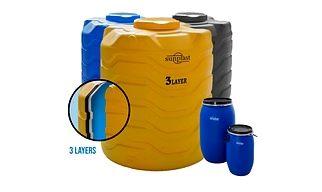
Water Tanks and Drums
A water tank is a container for storing water, for many applications, drinking water, irrigation, fire suppression, farming, both for plants and livestock, chemical manufacturing, food preparation as well as many other uses. Water tank parameters include the general design of the tank, and choice of construction materials, linings. Various materials are used for making a water tank: plastics (polyethylene, polypropylene), fiberglass, concrete, stone, steel (welded or bolted,[citation needed] carbon, or stainless).

HDPE Pipes & HDPE Fittings
HDPE pipes are a type of thermoplastic polymer pipe that is made from high-density polyethylene. These pipes have gained immense popularity in recent years due to their durability, strength, and flexibility. They are commonly used in a variety of applications such as water supply, gas transportation, and sewage systems.
High-density polyethylene is a versatile material that can withstand extreme temperatures, making it perfect for outdoor use. It is also resistant to chemicals, making it ideal for transporting hazardous materials. Additionally, HDPE pipes are lightweight, making them easy to transport and install.
One of the key benefits of HDPE pipes is their longevity. They are known to last for decades without any degradation in their performance. This makes them a cost-effective option in the long run as they require minimal maintenance and replacement.








 GL Trustmark