Our Products
Latest
Name (A-Z)
Name (Z-A)
Showing 1-5 of 5 products
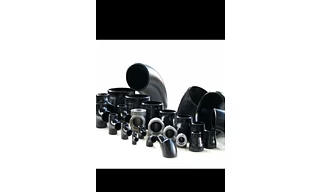
Industrial Elbow joint
The Industrial Elbow joint by UNA ENGINEERING is a robust and versatile component designed to deliver seamless performance in machinery applications.
Features
Features
- Durable construction for long-lasting usage
- Precise elbow angle for efficient connections
- Corrosion-resistant coating for enhanced durability
- Easy installation for quick setup
- Compatible with various machinery components
Price on Request
1 Numbers
MOQ
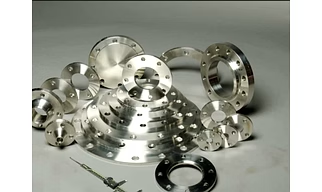
Flanged
Introducing Flanged, a versatile and durable machinery component from UNA ENGINEERING, crafted to enhance efficiency and performance in industrial settings.
Features
Features
- Made of high-quality materials for long-lasting reliability
- Precision engineering for accurate fit and functionality
- Resistant to corrosion and wear for extended lifespan
- Compatible with a wide range of machinery models
- Designed to optimize workflow and productivity
$ 5.67
/ Numbers
Price Range
1 Numbers
MOQ
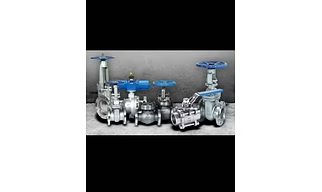
Industrial valves
Industrial valves are mechanical devices used to regulate, control, or direct the flow of liquids, gases, or slurries within a piping system. They play a critical role in industries such as oil & gas, power, water treatment, marine, and chemical processing.
1. Types of Industrial Valves
• Gate Valve
Used for on/off service with minimal pressure drop. Suitable for full flow applications.
• Globe Valve
Designed for throttling and flow control with better sealing capability.
• Ball Valve
Quarter-turn valve offering quick shut-off and low maintenance. Available in 1-piece, 2-piece, and 3-piece designs.
• Butterfly Valve
Lightweight and cost-effective valve for large diameter pipelines.
• Check Valve (NRV)
Prevents backflow in pipelines. Types include swing check and lift check.
• Plug Valve
Simple quarter-turn valve used for isolation in various industries.
2. Materials of Construction
WCB (Carbon Steel) – General industrial use
SS304 / SS316 (Stainless Steel) – Corrosion resistance
Cast Iron / Ductile Iron – Water and low-pressure applications
Alloy Steel – High temperature & pressure services
3. Pressure Classes
Class 150
Class 300
Class 600
PN10 / PN16 / PN25 / PN40
4. Size Range
½” (15 mm) to 48” (1200 mm) and above
5. End Connections
Flanged End
Screwed / Threaded End
Butt Weld End
Socket Weld End
6. Applications
Oil & Gas Industry
Petrochemical Plants
Power Plants
Water Treatment Systems
Marine & Ship Supply (IMPA Standard)
HVAC Systems
7. Key Features
High durability and long service life
Leak-proof sealing
Easy operation and maintenance
Available in manual, pneumatic, and electric actuated types
8. Standards & Testing
API, ANSI, ASME, BS, DIN Standards
Hydrostatic and pressure testing
Fire-safe and anti-static designs (for critical valves)
Price on Request
1 Numbers
MOQ
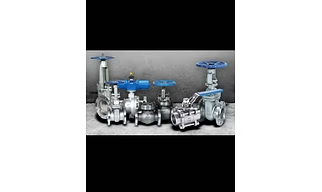
Industrial valves
Enhance your industrial operations with our high-quality Industrial Valves. Designed for durability and reliability, these valves ensure smooth control and efficient processes.
Features
Features
- Durable construction for long-lasting performance
- Reliable operation to minimize downtime
- Precise control for optimal fluid handling
- Easy installation and maintenance
- Suitable for various industrial applications
Price on Request
10 Numbers
MOQ
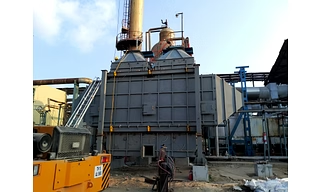
Industrial tank
Dust Collector
A dust collector is an industrial air pollution control system designed to capture, filter, and remove dust, fumes, and particulate matter from air or gas streams. It helps maintain clean air, worker safety, and regulatory compliance in industrial environments.
An industrial tank is a storage or processing vessel used to store, mix, or handle liquids, chemicals, gases, or bulk materials in industrial operations. These tanks are designed for safe storage, durability, and process efficiency across various industries.
⚙️ Functions
Storage of liquids (water, oil, chemicals)
Mixing and blending of materials
Settling and separation processes
Buffer storage in production lines
🏭 Types of Industrial Tanks
1. Storage Tank
Used for bulk liquid storage
Vertical or horizontal design
2. Mixing Tank
Equipped with agitator / stirrer
Used in chemical & pharma industries
3. Pressure Tank
Designed to handle internal pressure
Used for gas or pressurized liquids
4. Underground Tank
Installed below ground level
Used for fuel or hazardous liquids
5. Process Tank
Custom-designed for specific industrial operations
Price on Request
1 Numbers
MOQ

 GL Trustmark