Our Products
Latest
Name (A-Z)
Name (Z-A)
Showing 1-11 of 11 products

Polyethylene Granules
Polyethylene granules are versatile thermoplastic polymers widely used in producing plastic bags, containers, pipes, and household items. Available in various densities like LDPE and HDPE, they cater to specific application needs. LDPE offers flexibility for film applications, whereas HDPE provides rigidity for products demanding strength and durability. These granules exhibit excellent chemical and moisture resistance, ensuring product longevity and reliability across different environments.
Price on Request
1 KG
MOQ
Polypropylene Granules
Polypropylene granules are versatile thermoplastic polymers recognized for their chemical resistance, elasticity, and fatigue resistance. They are extensively utilized in manufacturing packaging materials, automotive parts, textiles, and consumer products. These granules are lightweight with a high melting point, making them suitable for heat-resistant applications. Their excellent electrical insulation properties make them ideal for electrical and electronic uses. Moreover, polypropylene granules resist moisture and numerous chemical solvents, ensuring durability across diverse environments.
Price on Request
1 KG
MOQ
ABS Granules
ABS granules are widely used thermoplastic polymers characterized by their toughness, rigidity, and ease of processing. They are commonly employed in producing automotive components, consumer electronics, and household appliances due to their excellent mechanical properties and visual appeal. ABS granules provide good impact resistance at low temperatures and can be easily colored, making them versatile for various applications. Their suitability for injection molding enables the creation of complex, precise shapes. Furthermore, ABS granules exhibit good chemical resistance and recyclability, supporting sustainable manufacturing efforts.
Price on Request
1 KG
MOQ
Nylon Granules
Nylon granules are engineering thermoplastics renowned for their strength, elasticity, and resistance to abrasion and chemicals. They are extensively utilized in manufacturing automotive components, textiles, and industrial parts. These granules provide excellent mechanical properties, such as high tensile strength and impact resistance, making them ideal for durable and high-performance applications. With good thermal stability, nylon granules can endure high temperatures, ensuring reliability in challenging environments. Their ease of processing through injection molding and extrusion facilitates the creation of complex shapes and designs.
Price on Request
1 KG
MOQ
Polystyrene Granules
Polystyrene granules are thermoplastic polymers characterized by their clarity, rigidity, and ease of processing. They are widely used in manufacturing disposable cutlery, CD cases, and packaging materials. These granules can be molded into diverse shapes and sizes, offering good dimensional stability and moisture resistance, which contribute to the durability of finished products. Furthermore, polystyrene granules can be combined with other materials to improve properties like impact resistance, broadening their application across various industries.
Price on Request
1 KG
MOQ
PVC Granules
PVC granules are versatile thermoplastic polymers extensively used in producing pipes, cables, flooring, and medical devices. Depending on application needs, they can be formulated to be either rigid or flexible. These granules provide excellent electrical insulation properties, making them suitable for electrical and electronic uses. With resistance to moisture and numerous chemicals, PVC granules ensure product longevity and reliability across various environments. Their ease of processing facilitates cost-effective manufacturing of complex shapes and designs.
Price on Request
1 KG
MOQ
PET Granules
PET granules are thermoplastic polymers recognized for their strength, transparency, and recyclability. They are commonly used in manufacturing beverage bottles, food containers, and textile fibers. These granules provide excellent barrier properties against moisture and gases, preserving the freshness and safety of packaged goods. With good chemical resistance and high-temperature tolerance, PET granules are suitable for diverse applications. Their ease of processing through injection molding and extrusion enables the creation of complex shapes and designs. The recyclability of PET granules supports sustainable manufacturing and environmental conservation efforts.
Price on Request
1 KG
MOQ
Polycarbonate Regrind
Polycarbonate regrind is recycled polycarbonate material processed into smaller particles for reuse, maintaining properties like high impact resistance, transparency, and thermal stability. It is commonly used in manufacturing automotive parts, electronic components, and construction materials. The use of regrind material offers cost savings and promotes environmental sustainability by minimizing waste and conserving resources. Blending polycarbonate regrind with virgin material allows manufacturers to achieve specific properties and performance characteristics in the final products.
Price on Request
1 KG
MOQ
PBT Granules
PBT granules are engineering thermoplastics characterized by high strength, stiffness, and resistance to heat and chemicals. They are extensively utilized in manufacturing automotive components, electrical parts, and consumer electronics. These granules provide excellent dimensional stability and low moisture absorption, ensuring product reliability and performance. With good electrical insulation properties, PBT granules are ideal for electrical and electronic applications. Their ease of processing through injection molding and extrusion facilitates the creation of complex shapes and designs. The chemical and high-temperature resistance of PBT granules ensures durability in challenging environments.
Price on Request
1 KG
MOQ
Polycarbonate Granules
Polycarbonate granules are versatile thermoplastic polymers renowned for their strength, transparency, and impact resistance. Widely utilized across industries like automotive, electronics, and construction, they are ideal for producing items such as lenses, compact discs, and protective equipment. These granules exhibit excellent thermal stability and flame retardant properties, ensuring safety in high-temperature environments. Their lightweight yet robust nature makes them suitable for applications demanding durability and ease of use.
Price on Request
1 KG
MOQ
ADHESIVE BOPP TAPE
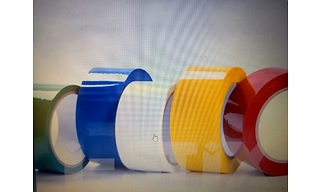
Our Adhesive BOPP Tape offers exceptional adhesive strength and durability for secure packaging solutions, ideal for various industries.
Features
Features
- Made of high-quality BOPP material for reliable performance
- Strong adhesive backing ensures secure sealing of packages
- Resistant to tearing and damage during transit
- Suitable for use in diverse environments and temperature conditions
- Available in various widths and lengths to meet different packaging needs
Price on Request
1 Kilogram
MOQ

 GL Trustmark