

Our Products
Showing 1-3 of 3 products
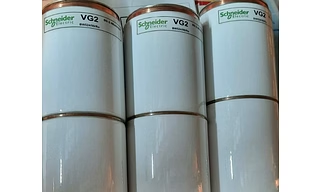
Vacuum Interrupter
11 KV Vacuum Interrupter for Vacuum Circuit Breaker Panel. Schneider and other brand we have Vacuum Circuit Breaker Definition: A vacuum circuit breaker is defined as a type of circuit breaker where arc quenching occurs in a vacuum, mainly used for medium voltage applications.
Vacuum Interrupter Structure: The vacuum interrupter, essential for VCB operation, consists of a steel arc chamber and ceramic insulators with a vacuum maintained at 10^-6 bar.
Contact Material: The material used for current-carrying contacts, typically copper-chromium (Cu/Cr), is crucial for the VCB’s performance.
Advantages of VCB: Vacuum circuit breakers have a long service life, minimal maintenance, no fire hazard, and are environmentally friendly.
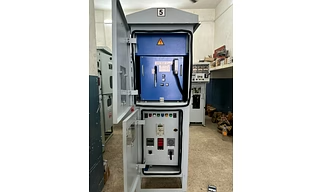
VCB Panel ICOG
The VCB (Vacuum Circuit Breaker) Panel is a high-performance electrical equipment designed to safely control and protect high-voltage power circuits, typically ranging from 11kV to 33kV. It is used in electrical systems to provide protection against short circuits and overload conditions, ensuring reliable operation in various industrial, commercial, and distribution substations.
The panel is designed and manufactured in accordance with international standards such as IEC 62271-100, IS 13118, and others.
7. Customization Options:

VCB Mechanism
The VCB operates by separating electrical contacts within a vacuum. When the contacts within the breaker separate, an arc is formed. However, in a vacuum environment, this arc is quickly extinguished because there are no gases or ionized particles to sustain it. This makes the vacuum a very effective medium for interrupting high-voltage currents.
Spring Charging Mechanism: A spring is charged (compressed) either manually or electrically, and when released, it provides the force necessary to move the contacts. This mechanism ensures rapid and consistent operation, which is critical for safely interrupting the circuit.
Trip Coil: This coil is energized to release the charged spring, initiating the opening of the contacts and hence breaking the circuit.
Close Coil: Opposite to the trip coil, this coil closes the contacts, allowing the circuit to complete.




 GL Trustmark