
Our Products
Showing 1-24 of 37 products
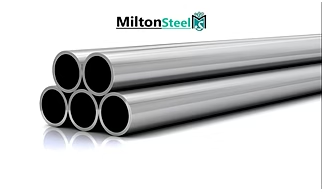
STAINLESS STEEL 310 SEAMLESS PIPE
Stainless steel 310 is an austenitic stainless steel with high chromium and nickel content that's used in applications that require high temperature resistance and corrosion resistance
These grades contain 25% chromium and 20% nickel, making them highly resistant to oxidation and corrosion. Grade 310S is a lower carbon version, less prone to embrittlement and sensitisation in service
310 stainless steel grade, which is also know as 1.4845 or 310s is a stainless grade which is commonly used in very high temperature envireoments. This grade is written as 1.4845 or X8CrNi25-21 according to EN norm and it is written as UNS S31008 according to UNS norm

STAINLESS STEEL 304 AND 316 FLANGE
Stainless steel flange simplified as SS flange, it refers to the flanges that made of stainless steel. Common material standards and Grades are ASTM A182 Grade F304/L and F316/L, with pressure ratings from Class 150, 300, 600 etc and to 2500
Stainless steel flanges are an essential component of pipes and tubes, which helps to connect them. They are circular disks with concentric ridges or projections on their surface that help to grip the pipes and tubes tightly. Stainless steel flanges are highly durable and can withstand high pressure and temperature
FLANGE ARE OF MANY TYPES SUCH AS
Welding Neck Flange
Slip-on Flange
Socket Weld Flange
Lap Joint Ring Flange
INCONEL 625
Inconel 625 is a nickel-based superalloy with high strength and corrosion resistance that's used in a variety of applications:
High-temperature applications
Inconel 625 is used in nuclear reactors, molds, pumps, and gas-turbine engine aircraft.
Alloy 625 / Inconel 625 is used for its high strength, excellent fabricability (including joining), and outstanding corrosion resistance. It has become a standard material of construction in a wide variety of industrial applications, which is unusual for an alloy
Inconel Alloy 625 (UNS designation N06625) is a nickel-based superalloy that possesses high strength properties and resistance to elevated temperatures. It also demonstrates remarkable protection against corrosion and oxidation
STAINLESS STEEL THERMOWELL
Thermowells are cylindrical fittings used to protect temperature sensors installed to monitor industrial processes. A thermowell consists of a tube closed at one end and mounted on the wall of the piping or vessel within which the fluid of interest flows
A thermowell is a cylindrical fitting used to protect temperature sensors installed when measuring liquid such as in the production of beer, the thermowell protects the thermometer when measuring the temperature as well as protects the liquid from contamination.
Stainless steel thermowells are typically made from stainless steel 304 or 316, which contain different percentages of chromium and nickel
STAINLESS STEEL FASTNERS
Common stainless steel fastener types include bolts, screws, nuts, studs, wingnuts, flat washers, and lock washers. Stainless steel's self-healing corrosion resistance provides an affordable and lower-maintenance alternative to treated or plated fasteners made from other materials
Stainless steel fasteners are one of the most common materials used in the construction industry. They are used to attach wood, metal, and other materials to structural beams. Stainless Steel Fasteners are also used to hold screws in place on these materials
Stainless steel is a corrosion-resistant alloy of iron, chromium and, in some cases, nickel and other metals. Completely and infinitely recyclable, stainless steel is the “green material” par excellence
17-4 PH ROUND BAR
17-4 is a chromium-nickel-copper precipitation hardening stainless steel used for applications requiring high strength and moderate level of corrosion resistance
The most well known precipitation hardening steel is 17-4 PH. The name comes from the additions 17% Chromium and 4% Nickel. It also contains 4% Copper and 0.3% Niobium. 17-4 PH is also known as stainless steel grade 630
17-4 pH stainless steel has a mean coefficient of thermal expansion of 6.0 x 10⁻⁶ in/in/°F with H900 heat treatment, whereas 316L ranges from approximately 9 to 11 x 10-6 in/in/°F. Technology such as thin film is limited to 17-4 PH because the temperature of the sputtering process is too high at the diaphragm
Monel 400 Sheets
Monel® Alloy 400. Monel 400 is a nickel-copper alloy (about 67% Ni – 23% Cu) that is resistant to sea water and steam at high temperatures as well as to salt and caustic solutions. Alloy 400 is a solid solution alloy that can only be hardened by cold working
Monel 400 is a nickel-copper alloy with excellent corrosion resistance in a wide variety of media. Monel 400 is characterized by good general corrosion resistance, good weldability and moderate to high strength. The alloy has been used in a variety of applications
Monel is used for marine engineering, chemical and hydrocarbon processing equipment, valves, pumps, shafts, fittings, fasteners, and heat exchangers. It is also used as part of metal instruments and frames of eyeglasses
STAINLESS STEEL 316 SHEET
Stainless Steel 316 Sheet / Plate is a type of metallic products that is produced in flat shape out of the 316 austenitic stainless steel. The ASTM A240 Type 316 is a specification for stainless steel sheets, plates and strips. The products under this specification are intended for pressure vessel applications
Grade 316 is an austenitic grade second only to 304 in commercial importance. 316 stainless steel contains an addition of molybdenum that gives it improved corrosion resistance. This is particularly apparent for pitting and crevice corrosion in chloride environments
Grade 316 stainless steel plate has a minimum tensile strength of 75 ksi and a yield strength at 0.2% of 30 ksi. 316 stainless steel plate has a 40% elongation. On the Brinell hardness scale 316 stainless steel plate has a hardness of 217 and a Rockwell B hardness of 95
Stainless Steel 316 L Round Bar
The 316L Stainless Steel Rod is widely used for heavy gauge welding applications. This is because due to its chemical composition, the rod is less susceptible to decay. The low carbon content helps in decreasing the carbide precipitation which sensitizes the weld's grain boundaries in these materials
316L has a lower proportion of carbon in its composition. To qualify as 316L stainless steel, the amount of carbon cannot exceed 0.03%. This decreases the risk of carbon precipitation, making it a better option for welding to ensure maximum corrosion resistance
The SS 316 Hex Bar Sizes range from 18mm to 57mm and these are stronger because of the geometrical shape. The minimum tensile strength of the material is at 515MPa and the minimum yield strength is at 205MPa. The hardness is 217BNH maximum for these products
STAINLESS STEEL SHEET 420
Stainless Steel Sheet 420 is a martensitic stainless steel that provides good corrosion resistance. It is similar to 410 with increased strength and hardness and is magnetic in both the annealed and hardened conditions. Maximum corrosion resistance is attained only in the fully hardened condition
420 stainless steel is a martensitic higher carbon version of types 410 and 416 stainless that can be hardened by heat treatment. It contains a minimum of 12 percent chromium, sufficient to give 420 corrosion resistance properties
Stainless steel, also known as inox, corrosion-resistant steel (CRES), and rustless steel, is an alloy of iron that is resistant to rusting and corrosion. It contains iron with chromium and other elements such as molybdenum, carbon, nickel and nitrogen depending on its specific use and cost
INCONEL 625 HEX NUT
The Inconel 625 Bolts and Nuts are designed with superior mechanical properties and strength. They possess a minimum tensile strength of 930Mpa and a minimum yield strength of 517Mpa. They can be easily elongated by 42.5% and still possess excellent workability
INCONEL alloy 625 is used in wire rope, propeller blades, propulsion motors and sheathing for undersea communication cables. Other uses for the INCONEL alloy range include down-hole equipment, platform risers, hangers and high-strength fasteners
Inconel 625 hex nuts are a type of fastener that are known for their strength, corrosion resistance, and ability to withstand high temperatures
INCONEL 625 HEX NUT
STAINLESS STEEL 904L SHEET
Alloy 904L (UNS N08904) is a superaustenitic stainless steel designed for corrosion and pitting resistance in a wide range of process environments. It is used extensively in the chemical process industry including the production of phosphate-based fertilizers
904L stainless steel is a superaustenitic stainless steel that's known for its high corrosion resistance. It's often used in storage containers, tankers, and panels
Stainless steel, also known as inox, corrosion-resistant steel (CRES), and rustless steel, is an alloy of iron that is resistant to rusting and corrosion. It contains iron with chromium and other elements such as molybdenum, carbon, nickel and nitrogen depending on its specific use and cost
TITANIUM PALTE SHEET
Titanium sheet is employed in many applications across aerospace, medical, industrial, and oil and gas industries. Selected for its unique combination of high strength, light weight, corrosion resistance, bio-compatibility, and higher temperature performance
Titanium Sheet is selected for unique combination of high strength, light weight, corrosion resistance, biocompatibility, and higher temperature performance. Titanium Sheet thicknesses range from 0.012" (0.304mm) to 0.160" (4.165mm). Titanium Grade 2 Sheet: ASTM B265 Gr 2, ASME SB265, ASTM F67
Commonly referred to as Ti-6AL-4V (or Ti 6-4), this designation refers to its chemical composition of almost 90% titanium, 6% aluminum, 4% vanadium, 0.25% (max) iron and 0.2% (max) oxygen. It features excellent strength, low modulus of elasticity, high corrosion resistance, good weldability and it is heat treatable


 GL Trustmark