
 FIEO Registered
Our Products
Showing 1-3 of 3 products
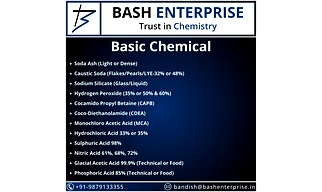
Basic Chemicals
1. Alkaline Compounds & pH Modifiers
Soda Ash (Light/Dense) – Used in glass manufacturing, water treatment, and detergents.
Caustic Soda (Flakes/Pearls/LYE 32% or 48%) – A strong alkali used in soap making, textiles, pulp & paper, and chemical processing.
2. Silicates & Oxidizers
Sodium Silicate (Glass/Liquid) – Used in detergents, adhesives, cement, and water treatment.
Hydrogen Peroxide (35%, 50%, 60%) – A bleaching and disinfecting agent in textiles, paper, and wastewater treatment.
3. Surfactants & Emulsifiers
Cocamidopropyl Betaine (CAPB) – A mild surfactant used in personal care products like shampoos and liquid soaps.
Coco-Diethanolamide (CDEA) – A foam booster and viscosity enhancer in detergents and cosmetics.
4. Acids & Chemical Intermediates
Monochloro Acetic Acid (MCA) – Used in agrochemicals, pharmaceuticals, and surfactant production.
Hydrochloric Acid (33% or 35%) – Used in pH control, pickling of metals, and industrial cleaning.
Sulfuric Acid (98%) – A key industrial acid used in fertilizers, battery production, and chemical manufacturing.
Nitric Acid (61%, 68%, 72%) – Used in explosives, fertilizers, and metal refining.
Glacial Acetic Acid (99.9%) (Technical/Food) – Used in food additives, vinegar production, and industrial solvents.
Phosphoric Acid (85%) (Technical/Food) – Used in fertilizers, food-grade additives, and metal treatment.
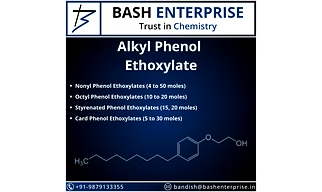
Alkyl Phenol Ethoxylate
1. Overview:
Alkyl Phenol Ethoxylates (APEs) are a group of non-ionic surfactants derived from alkylphenols (such as nonylphenol or octylphenol) and ethylene oxide. They are widely used in industrial and household applications due to their emulsifying, wetting, and dispersing properties.
2. Chemical Structure:
APEs consist of an alkylphenol hydrophobic group attached to an ethoxylated hydrophilic chain. The length of the ethoxylate chain determines the solubility and surfactant properties of the compound.
3. Applications:
Industrial Cleaners: Used in detergents, degreasers, and emulsifiers.
Textile & Leather Processing: Improves dye penetration and wetting.
Agriculture: Used in pesticide formulations as emulsifiers.
Paints & Coatings: Acts as a dispersant and stabilizer.
Oil & Gas: Used in enhanced oil recovery and drilling fluids.
4. Environmental & Health Concerns:
APEs, especially Nonylphenol Ethoxylates (NPEs), degrade into Nonylphenol (NP), which is toxic to aquatic life and an endocrine disruptor.
Due to environmental concerns, regulations in many regions (e.g., EU, US) have restricted or banned APE use, promoting alternative biodegradable surfactants.
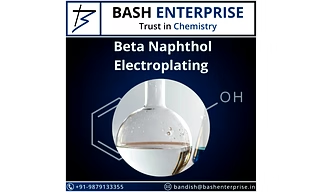
Beta Naphthol Electroplating
1. Overview:
Beta Naphthol (2-Naphthol) is an organic compound primarily used in dyes, resins, and as an intermediate in chemical synthesis. In electroplating, it is not commonly used as a direct electrolyte component but may be involved in specialized plating processes or as an additive in organic synthesis related to electroplating formulations.
2. Possible Roles in Electroplating:
Brightening Agent: Some naphthol derivatives or related compounds are used in electroplating baths to improve surface finish.
Corrosion Inhibitor: In certain formulations, naphthol-based compounds may contribute to preventing oxidation.
Intermediate for Plating Additives: Beta Naphthol is a precursor for various sulfonated compounds that may be used in electroplating solutions.
3. Electroplating Applications:
Beta Naphthol itself is not a major direct component in plating baths, but derivatives like Naphthol Sulfonic Acid can be used in:
Nickel Plating: As part of brightener formulations.
Copper and Silver Plating: In some specialized bath compositions.
Electrolytic Coloring Processes: As a dye intermediate in anodized aluminum coloring.



 GL Trustmark