


For years, “digital transformation” sounded like something reserved for Fortune 500 boardrooms and well-funded firms. Today, it looks very different. It looks like a small manufacturing unit predicting demand using AI. It looks like a boutique agency automating client onboarding. It looks like a two-person team making decisions with the confidence of a much larger company.
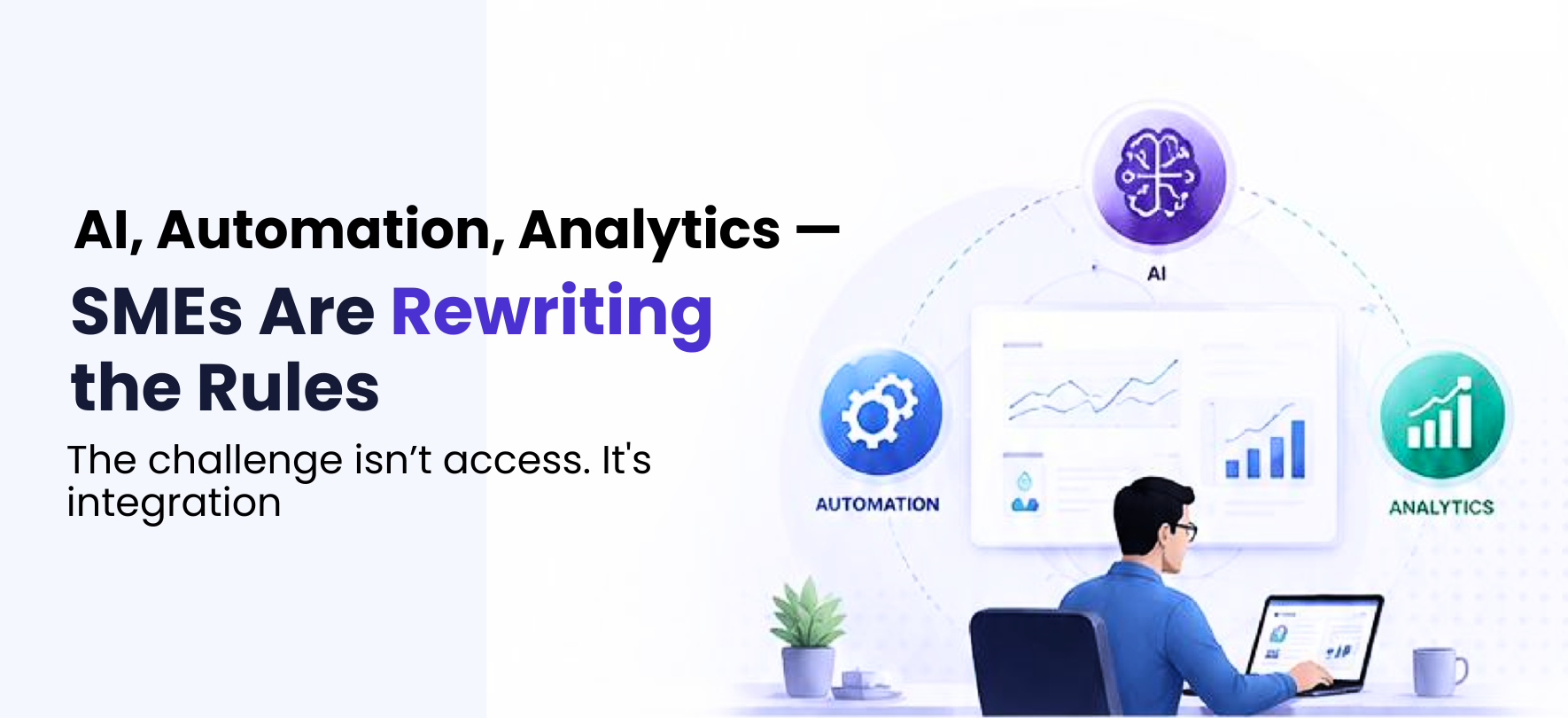
In other words, digital transformation has finally become accessible. And for SMEs, it is no longer optional. This is where Artificial Intelligence (AI), automation, and analytics come in. Not as buzzwords, but as practical tools that solve everyday business problems. The real challenge, however, is not access to these tools, but bringing them together in a way that actually works for the business.
AI Tools: From Curiosity to Core Tasks
AI adoption in SMEs rarely starts with grand ambition. It starts with a simple need. A business wants to respond to customer queries faster. An exporter wants sharper insights on the overseas market. A B2B seller wants to forecast inventory better. A manufacturer wants to generate product descriptions that actually convert.
SMEs are using AI tools like ChatGPT, Claude and Gemini for writing emails, customer support chatbots, marketing campaigns and even financial projections. The real transformation is not just efficiency, it is also confidence. When decisions are backed by data patterns and readily accessible research, businesses move faster and take smarter risks.
In fact, through a series of webinars, GlobalLinker has been helping SMEs make sense of the growing ecosystem of AI tools and the importance of having an AI-understandable website.
Automation: Doing More Without Hiring More
Ask any SME founder about their biggest constraint and the answer is almost always the same: time and money.
Automation has quietly become the most practical entry point into digital transformation. CRM systems now handle lead tracking and follow-ups automatically. Invoicing, payroll, and inventory updates happen with minimal human intervention.
Many SMEs discover that automation is not about replacing people; it is about freeing them up to focus on work that actually moves the needle.
What used to require a team can now be managed by a handful of well-integrated tools. The impact is immediate. Fewer errors, faster turnaround. Interestingly, many SMEs discover that automation is not about replacing people; it is about freeing them up to focus on work that actually moves the needle.
Analytics: Turning Data Into Direction
Data used to be overwhelming. Now it is actionable. SMEs today are leveraging analytics dashboards that translate complex datasets into clear insights. Which products are performing best? Where are customers dropping off? Which marketing channels actually deliver ROI?
These are no longer questions that require expensive consultants. They are answered in real time. What makes analytics powerful is not just visibility, but alignment. Teams can see the same data and make decisions faster, without endless back-and-forth. And when AI is layered on top of analytics, it starts to do more than report. It begins to recommend.
Why Global Uncertainty Is Speeding Things Up
The current global landscape is unpredictable. Trade tensions, regulatory changes, political unrest in several parts of the world and shifting alliances are forcing businesses to rethink their dependencies.
For SMEs, this means two things: (1) They need more control (2) They need more visibility. AI and digital tools provide both.
When supply chains fluctuate, predictive analytics helps adjust sourcing strategies. For instance, several SME exporters in clusters like Surat and Moradabad adapted quickly during COVID by using digital order data to realign production with changing international demand. When customer behavior shifts, AI-driven insights help businesses pivot offerings, much like how hyperlocal players such as Blinkit and BB Now responded to changing consumption patterns. When costs rise, automation helps maintain margins, something many small manufacturers and distributors have achieved by streamlining inventory, invoicing, and fulfillment through digital tools.
In a way, global instability is pushing SMEs toward digital maturity faster than any internal strategy ever could.
Where a Smart Platform Fits In
As SMEs navigate this transformation, one challenge becomes clear. The tools exist, but connecting them meaningfully is not always straightforward.
This is where a platform like GlobalLinker fits in, especially for manufacturers, traders, and exporters looking to move quickly. It enables businesses to build an AI-ready digital presence through structured B2B websites and digital catalogues with speed, cost-efficiency and minimal complexity. At the same time, it opens up multiple sales channels, helping business owners become more discoverable to the right buyers.
For SMEs, visibility is no longer just about being online. It is about being structured, searchable, and understandable to both humans and machines.
“AI-ready” is not just a buzzword here. Buyers themselves are increasingly using tools like ChatGPT, Gemini and Claude to search, compare, and shortlist suppliers. Even search engines are evolving, with discovery becoming more influenced by AI-driven insights.
For SMEs, this means visibility is no longer just about being online. It is about being structured, searchable, and understandable to both humans and machines.
Road ahead
Digital transformation for SMEs is no longer about catching up with large enterprises. It is about building smarter, more agile businesses. It is a series of upgrades that reshape how a business operates.
Access isn’t the challenge anymore. Integration is.
Image source: Canva
Disclaimer: The views and opinions expressed in this article are those of the author and do not necessarily reflect the views, official policy or position of GlobalLinker.
Posted by
Supriya MathurMy endeavour is to help business owners digitise, network and grow easily. Towards this I help organise webinars, curate articles and answer queries via our help centre.
More Articlesby this author
Communications Manager
GlobalLinker / Mumbai, India
3°+ / 2318 Connections